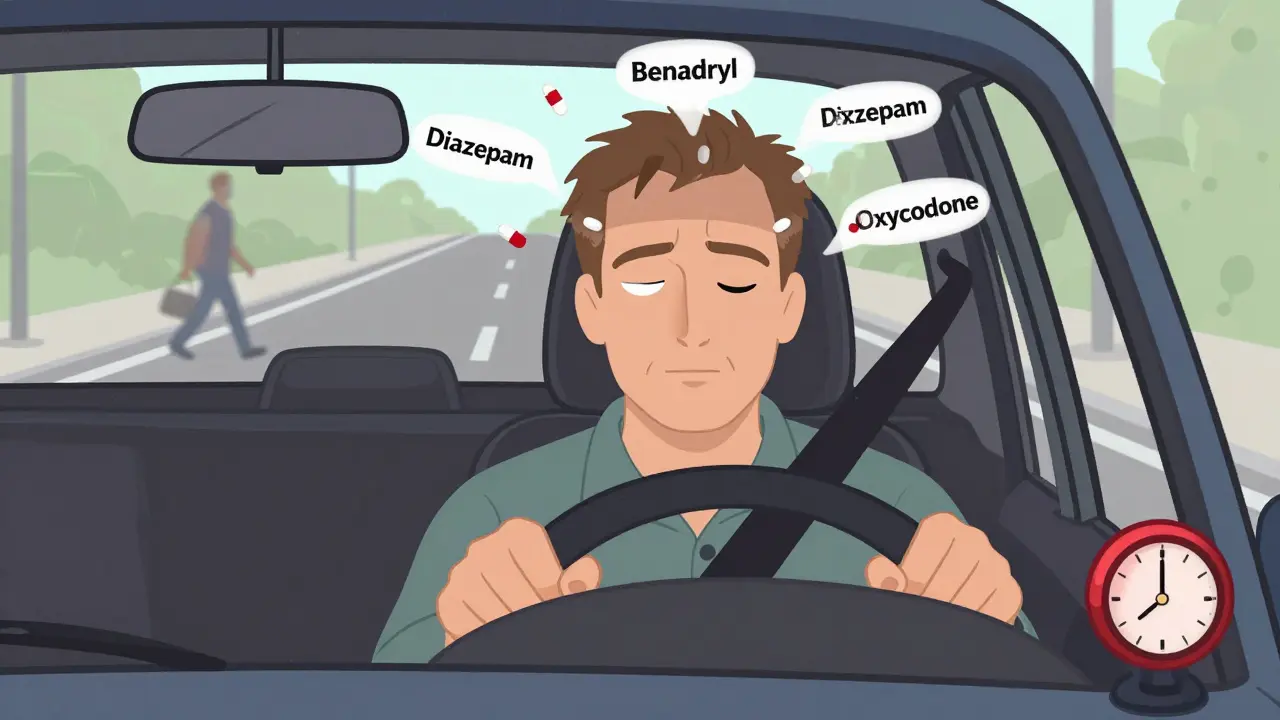
Driving while on medication might feel harmless-after all, you’re just taking what your doctor prescribed. But many common drugs, even ones you can buy over the counter, can slow your reactions, blur your vision, or make you drowsy without you even realizing it. In Australia, where long drives are part of daily life, this isn’t just a theoretical risk-it’s a growing cause of crashes, injuries, and deaths. The truth is, you don’t need to be drunk to be legally and dangerously impaired behind the wheel.
What Medications Really Do to Your Driving Skills
It’s not just about feeling sleepy. Medications affect how your brain processes information, how fast your body reacts, and how well you coordinate movements. A study from the National Highway Traffic Safety Administration found that drugs impair driving in ways similar to alcohol: reduced reaction time, poor judgment, blurred vision, and trouble tracking moving objects. Some drugs, like benzodiazepines (e.g., diazepam or alprazolam), can slow your brain’s processing speed by up to 40%. That means if a car suddenly stops in front of you, you might not hit the brake fast enough.
Opioids like oxycodone or fentanyl don’t just cause drowsiness-they tighten your pupils, making it harder to see at night or in low light. They also delay your response time by up to 300 milliseconds. That’s the difference between stopping in time and hitting a pedestrian crossing the road.
Even stimulants like amphetamines, often prescribed for ADHD, can backfire. They might make you feel alert at first, but as the effect wears off, you crash into a state of extreme fatigue and inattention. Many drivers don’t realize they’re in that dangerous zone until it’s too late.
The Hidden Dangers in Your Medicine Cabinet
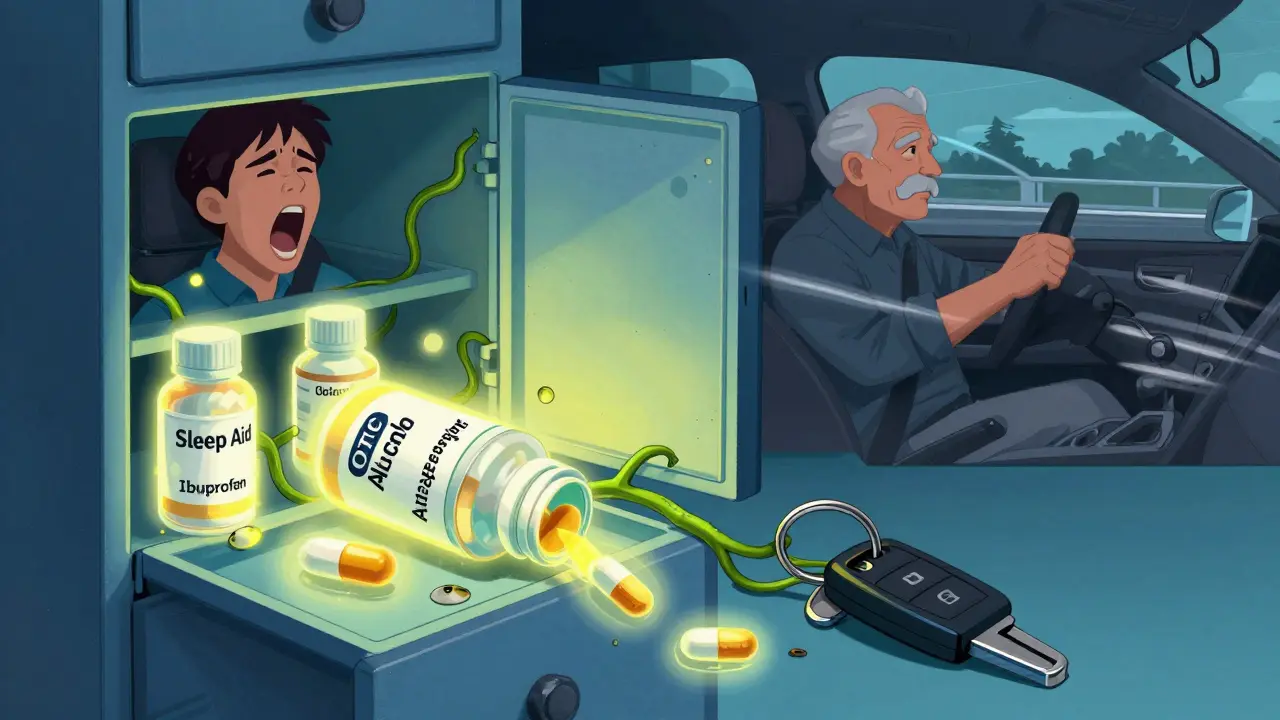
You might think only strong prescription drugs are risky. But over-the-counter (OTC) meds are just as dangerous-and far more common.
Take diphenhydramine, the active ingredient in Benadryl, Tylenol PM, and many sleep aids. A single dose can impair your driving as much as a blood alcohol concentration (BAC) of 0.10%. That’s above the legal limit of 0.08% in every U.S. state and in Australia. One 2021 survey found that 5% of drivers admitted to driving within two hours of taking an OTC sleep aid. Many didn’t know the risk.
Even common painkillers like ibuprofen and naproxen carry hidden dangers. Research from LeRoy and Morse showed a 58% higher crash risk among users. Why? These drugs can cause dizziness, blurred vision, or sudden fatigue, especially in older adults or when taken with other meds.
Antidepressants, particularly older tricyclic types and mirtazapine, increase the chance of a motor vehicle crash by 40%. The effect isn’t dramatic at first-but over time, it adds up. A 2014 review found a Standardized Incidence Ratio (SIR) of 1.4, meaning drivers on these meds had 40% more crashes than those not taking them.
Why Age Makes It Worse
If you’re over 65, your body handles drugs differently. Your liver and kidneys don’t clear medications as quickly. Your brain becomes more sensitive to their effects. Even a dose that was safe at 50 can become dangerous at 70.
According to experts at Mount Sinai Health System, older adults are at higher risk because their bodies retain more of the drug and respond more strongly to it. That’s why the Beers Criteria, updated in 2019, lists over 30 medications that should be avoided in seniors-including many sleep aids, antihistamines, and muscle relaxers-because of their impact on driving.
One man in Darwin, 72, took his nightly dose of an antihistamine for allergies. He woke up feeling fine, drove to the grocery store, and was pulled over for swerving. He didn’t realize the medication was still in his system 12 hours later. He failed a field sobriety test. He wasn’t drunk. He wasn’t high. He was just taking a common OTC pill.
Combining Drugs Is a Recipe for Disaster
The biggest danger isn’t one drug-it’s the mix.
Studies show that drivers who take three or more impairing medications are far more likely to crash. The effects aren’t just added-they multiply. Alcohol and benzodiazepines together? Crash risk jumps over 100%. Opioids and sleep aids? Reaction time drops by 50%.
A 2020 study tested drivers at trauma centers and found 22% had multiple drugs in their system-often a mix of prescription meds, alcohol, and sometimes marijuana. The impairment wasn’t just additive; it was synergistic. One drug made another even more dangerous.
And here’s the scary part: most people don’t know they’re combining risky meds. A 2022 survey found that 68% of patients received no warning from their doctor about driving risks when prescribed these drugs. Pharmacists are better at flagging risks-but even then, only 89% now routinely discuss driving, according to a 2023 report.
Legal Consequences Are Real-and Harsh
In Australia, driving under the influence of drugs-including prescription medications-is illegal. Police can pull you over, test your saliva, and charge you even if you took your meds exactly as prescribed. There’s no legal exception for “I was following my doctor’s orders.”
Unlike alcohol, where the legal limit is clear (0.05% BAC in most states), there’s no universal threshold for prescription drugs. Some states have specific limits for certain medications, but most rely on officer judgment. If you’re impaired, you’re guilty.
Penalties vary but can include license suspension, fines, mandatory drug education, and even jail time. A 2023 case in South Australia saw a 68-year-old man lose his license for 12 months after testing positive for diazepam and zolpidem following a minor crash. He had taken them as directed. The court still ruled he was unfit to drive.
How to Stay Safe-Practical Steps You Can Take
It’s not about stopping your meds. It’s about managing the risk.
- Know your meds. Check the label for warnings like “may cause drowsiness,” “do not operate machinery,” or “avoid driving.” If it’s not clear, ask your pharmacist.
- Wait it out. For first-generation antihistamines (like diphenhydramine), wait at least 6 hours. For sleep aids like zolpidem (Ambien), wait 8-12 hours. Don’t rely on how you feel-drugs can linger.
- Don’t mix. Never combine medications with alcohol, marijuana, or other sedatives. Even two legal drugs can become dangerous together.
- Ask for alternatives. If you take a sedating antihistamine, ask if a non-drowsy option like loratadine (Claritin) or cetirizine (Zyrtec) works for you. For pain, consider non-medication options like physical therapy.
- Use a driving self-check. Try the University of Iowa’s simulator test: if you can complete 15 maneuvers with less than 1.5 lane deviations, you’re likely safe to drive. If not, don’t risk it.
The Future Is Here-And It’s Watching
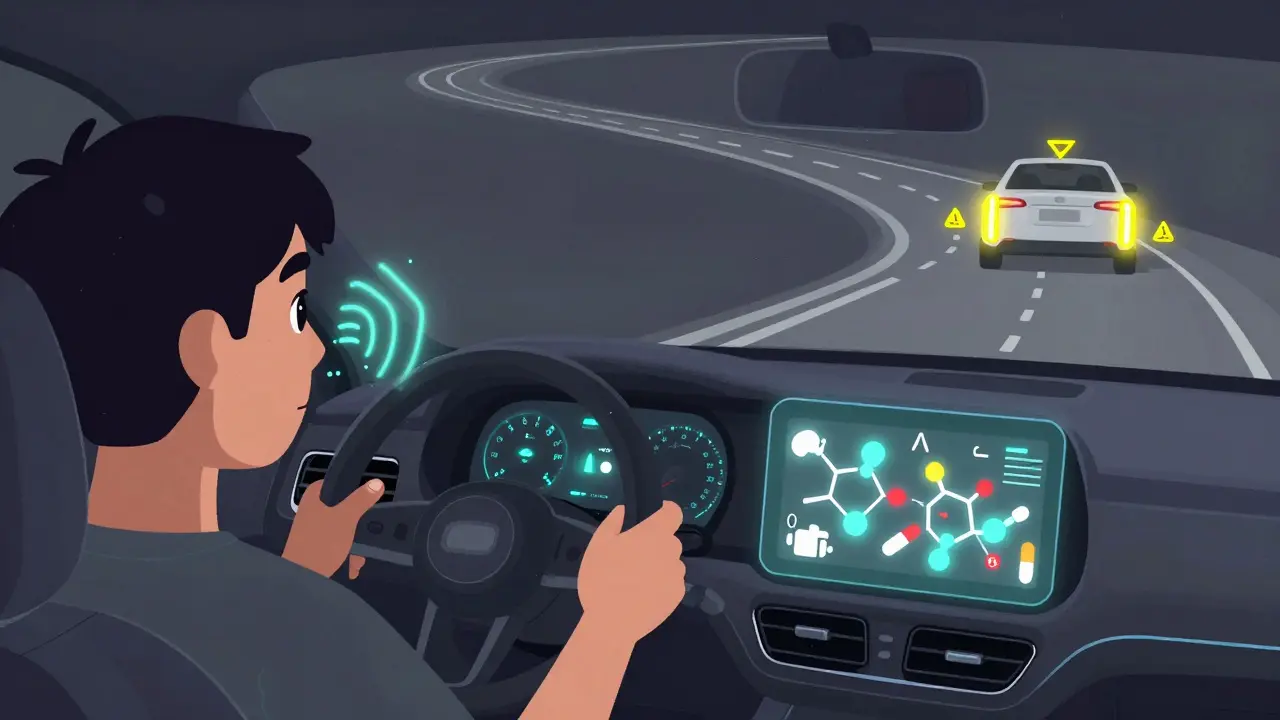
By 2027, most new cars will have sensors that track your eye movements and steering patterns. If you’re drowsy or impaired, the car might alert you-or even stop itself. That’s not science fiction. The 2024 IIHS study confirmed this tech is already in development.
But until then, the responsibility is yours. No system can replace your own awareness. And no law can protect you if you ignore the warnings.
Medication isn’t the enemy. Ignorance is. You don’t need to stop driving because you take pills. But you do need to know which ones are risky-and when it’s safer to leave the keys behind.
Can I get charged with DUI even if I have a prescription for the drug?
Yes. Having a prescription doesn’t make it legal to drive if the drug impairs you. Police don’t care if your doctor prescribed it-they care if you’re unsafe behind the wheel. In Australia and most U.S. states, driving while impaired by any drug-prescription or not-is illegal.
How long after taking a medication should I wait before driving?
It depends on the drug. For first-generation antihistamines like diphenhydramine (Benadryl), wait at least 6 hours. For sleep aids like zolpidem (Ambien), wait 8-12 hours. For opioids, wait at least 8 hours. But the best rule? If the label says "may cause drowsiness," assume it’s unsafe to drive until you’ve tested yourself in a safe environment-like a quiet parking lot-after your first few doses.
Are over-the-counter meds safer than prescription drugs for driving?
No. Many OTC meds are just as impairing as prescription ones. Diphenhydramine, found in sleep aids and cold medicines, can impair you as much as a 0.10% BAC-higher than the legal limit for alcohol. NSAIDs like ibuprofen can also increase crash risk by 58%. Don’t assume OTC means safe.
What should I do if my doctor prescribes a medication that affects driving?
Ask three things: 1) Is there a non-drowsy alternative? 2) How long will the effects last? 3) Should I avoid driving entirely for the first few days? If your doctor doesn’t bring up driving, ask. Pharmacists are trained to warn about this too-use them as a second opinion.
I feel fine after taking my meds. Why can’t I drive?
Feeling fine doesn’t mean you’re safe. Medications can reduce your reaction time, blur your vision, or make you less aware of danger-all while you feel alert. Studies show people consistently overestimate how well they’re driving after taking impairing drugs. That’s why objective tests, like driving simulators, are more reliable than how you feel.



Kal Lambert
15 March / 2026I drive every day on meds for anxiety. Never had an issue. But I also never drive after taking my dose. I wait till the next morning. Simple. Read the label. If it says 'may cause drowsiness' - don't drive till it's out of your system. No drama needed.