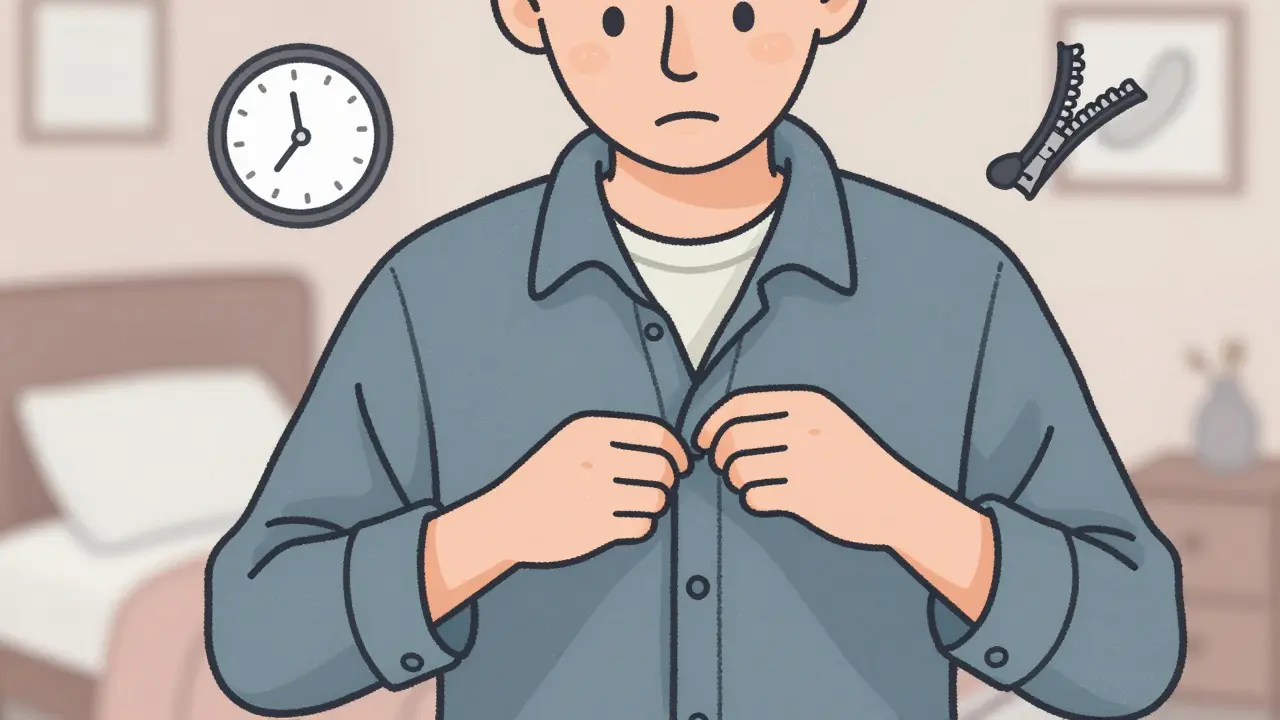
Living with Parkinson’s disease means navigating a body that no longer moves the way it used to. It’s not just about shaking hands. It’s about taking three times longer to button a shirt, forgetting how to turn over in bed, or suddenly freezing mid-step while walking. For more than 1 million Americans, this isn’t theoretical-it’s daily reality. Parkinson’s is a brain disorder that slowly steals control of movement, and while there’s no cure yet, knowing what to expect and how to manage it can make a huge difference in staying independent longer.
What Are the Core Motor Symptoms?
The four main motor symptoms of Parkinson’s are unmistakable once you know what to look for: tremor, rigidity, bradykinesia, and postural instability. You don’t need all four to be diagnosed, but bradykinesia-slowness of movement-is always there. It’s the silent engine behind most of the challenges people face.
Tremor is what most people picture: a rhythmic shaking, often starting in one hand as a "pill-rolling" motion between thumb and finger. About 70% of people first notice this symptom, but 20-30% never develop noticeable tremor at all. The shaking usually happens when the hand is resting, not when reaching for a cup. It fades with movement, which is why some people can hold a glass steady but struggle to write their name.
Rigidity feels like stiffness in the limbs or neck. It’s not just muscle tightness-it’s resistance that doesn’t give way easily. Some people describe it as a "cogwheel" feeling, like turning a rusty gear, while others feel a constant, smooth resistance, like bending a lead pipe. This stiffness makes simple motions, like swinging your arms while walking, feel stiff and unnatural.
Bradykinesia is the most telling sign. It’s not just slow movement-it’s the brain struggling to initiate or complete actions. Facial expressions flatten. Blinking slows down. Steps get shorter. Writing turns into tiny, cramped letters called micrographia. Buttoning a shirt can take over three times longer than it used to. Even smiling or raising an eyebrow becomes effortful. This symptom shows up early, often before tremor, and gets worse over time.
Postural instability comes later, usually after five to ten years. It’s the loss of balance that makes falls common. People with Parkinson’s often lean forward, have trouble stopping when walking, or can’t catch themselves when bumped. About 68% of people with Parkinson’s fall at least once a year. Many fall more than once. This isn’t just clumsiness-it’s the brain losing its ability to adjust posture automatically.
Other Motor Signs You Might Not Notice
Beyond the big four, there are quieter symptoms that quietly erode independence. Reduced arm swing during walking affects 75% of people. It doesn’t seem like much, but it throws off balance and makes walking feel unsteady. Stooped posture creeps in over time, with 65-80% of people developing a forward bend in the spine. Speech changes are common too: voice volume drops by 5-10 decibels, making conversations harder. About 89% of people develop a soft voice, and 74% struggle with slurred speech.
Drooling happens in half to 80% of cases-not because of excess saliva, but because swallowing becomes less frequent. The brain forgets to trigger the swallow reflex. Swallowing problems, or dysphagia, affect 35% early on and climb to 80% in advanced stages. This isn’t just uncomfortable-it raises the risk of choking and pneumonia, which is the leading cause of death in Parkinson’s.
Dystonia, or painful muscle spasms, often appears in younger patients. Toes curl, feet twist, or the neck pulls sideways. These spasms can be so severe they make walking impossible for minutes at a time. And then there’s akathisia-a restlessness that makes you feel like you need to keep moving, even when you’re sitting still. It’s exhausting and often mistaken for anxiety.
How Medications Work-and Where They Fall Short
Medications don’t stop Parkinson’s. They don’t rebuild dead brain cells. But they do help the brain work better with what’s left. The most powerful tool is levodopa, a chemical that turns into dopamine in the brain. It’s been the gold standard since 1967. About 70-80% of people get strong relief from it at first. But after five years, about half develop side effects: unpredictable "on-off" periods where medication works one minute and vanishes the next, or involuntary movements called dyskinesias-flailing limbs or twitching that feel uncontrollable.
Because of this, doctors often start younger patients on dopamine agonists like pramipexole or ropinirole. These mimic dopamine without turning into it. They’re less powerful than levodopa but cause fewer long-term movement problems. They help about 50-60% of early-stage patients, but can cause nausea, dizziness, or even impulse control issues like gambling or overeating.
As the disease progresses, many people need combinations of drugs: levodopa with carbidopa (to help it reach the brain), MAO-B inhibitors to slow dopamine breakdown, or COMT inhibitors to extend levodopa’s effect. None of these stop the disease, but they help stretch the good days.
For those who don’t respond well to pills anymore, deep brain stimulation (DBS) is an option. About 30% of people reach this point after 10 years. Electrodes are implanted in the brain to send pulses that block abnormal signals. It doesn’t cure anything, but it can reduce tremor, rigidity, and dyskinesia by up to 50% in the right candidates. It’s surgery, and it’s not for everyone-but for some, it’s the only thing that brings back control.

Daily Life: The Real Battle
The hardest part of Parkinson’s isn’t the shaking. It’s the loss of autonomy. Simple things become battles. Getting dressed takes longer. Showering becomes risky. Cooking means watching for spills or burns. Many people stop driving because reaction times slow and turning the head to check blind spots feels impossible.
Turning over in bed is harder than it sounds. About 65% of people struggle with this within five years of diagnosis. They get stuck, unable to roll or push up. Sleep suffers. Fatigue sets in. And then there’s the emotional toll. Depression and anxiety affect up to half of people with Parkinson’s-not just because of the diagnosis, but because the brain changes that cause movement problems also affect mood chemicals.
Sexual dysfunction hits 50-80% of men with Parkinson’s. It’s not just about desire-it’s about nerve signals, medication side effects, and physical stiffness. It’s rarely talked about, but it’s a major source of stress in relationships.
Speech becomes harder to understand. People stop answering the phone. They avoid gatherings. Social isolation creeps in. And when swallowing gets worse, meals turn into anxiety-inducing events. Eating becomes slow, messy, and dangerous. Nutritional decline is common.
What Helps Beyond Pills
Medication isn’t the only tool. Exercise is one of the most powerful things you can do. Studies show 12 weeks of targeted physical therapy improves walking speed by 15-20% and cuts fall risk by 30%. Tai chi, dance, boxing, and even brisk walking help maintain balance and coordination. The goal isn’t to get stronger-it’s to stay mobile.
Speech therapy can help with volume and clarity. Techniques like the Lee Silverman Voice Treatment (LSVT LOUD) train the brain to use a louder voice. Occupational therapy helps adapt the home: non-slip mats, raised toilet seats, rocker knives, and clothing with magnetic buttons instead of zippers.
Support groups aren’t just for talking. They’re for learning. People share tricks: how to break a freeze by stepping over a line on the floor, how to use a weighted spoon to steady a trembling hand, how to use voice assistants to control lights and music without moving.
What’s Next?
No medication today can slow or stop Parkinson’s. But research is moving fast. Scientists are testing drugs that target alpha-synuclein, a protein that clumps in the brains of people with Parkinson’s and kills dopamine cells. Clinical trials are underway. Some show early promise. The hope isn’t just better symptoms-it’s a future where Parkinson’s isn’t inevitable.
For now, the focus stays on living well. It’s about adapting, not surrendering. It’s about finding the right mix of meds, movement, and support to keep doing the things that matter-talking to grandchildren, gardening, laughing with friends, even just getting out of bed without help.
Can Parkinson’s be diagnosed with a blood test or scan?
No. There’s no blood test, MRI, or scan that can definitively diagnose Parkinson’s. Diagnosis is based on clinical evaluation-watching how someone moves, asking about symptoms, and checking response to levodopa. A neurologist looks for bradykinesia plus tremor or rigidity. If symptoms improve significantly after taking levodopa, that’s strong evidence of Parkinson’s.
Is Parkinson’s genetic?
Most cases aren’t inherited. Only about 10-15% of people with Parkinson’s have a clear family history. A few rare gene mutations, like LRRK2 or GBA, can increase risk, but even then, having the mutation doesn’t guarantee you’ll get the disease. For the vast majority, it’s a mix of aging, environment, and unknown factors-not genetics.
Does everyone with Parkinson’s end up in a wheelchair?
No. Many people live for decades with Parkinson’s and remain mobile. The Hoehn and Yahr scale describes five stages, but progression varies widely. Some stay at Stage 2 (mild symptoms on both sides) for 10+ years. Others progress faster. With good management-medication, exercise, therapy-many never reach Stage 5 (wheelchair or bed-bound). The goal is to slow decline, not just wait for it.
Can diet affect Parkinson’s symptoms?
Yes, in a few key ways. High-protein meals can interfere with levodopa absorption, so some people take their medication 30-60 minutes before eating. Constipation is common, so fiber, water, and movement help. A balanced diet supports overall health, which matters when the body is under stress. There’s no "Parkinson’s diet," but avoiding extreme protein spikes and staying hydrated makes a difference.
Why do some people with Parkinson’s get hallucinations?
Hallucinations are often a side effect of medications, especially dopamine agonists or high doses of levodopa. They’re more common in older patients or those with cognitive changes. They usually involve seeing people or animals that aren’t there. They’re not always frightening-some people just notice a cat on the couch that isn’t real. If they become distressing, doctors can adjust meds or add drugs like pimavanserin, which targets hallucinations without worsening movement.
Is it safe to exercise with Parkinson’s?
Yes-and it’s essential. Exercise doesn’t cure Parkinson’s, but it helps the brain compensate. Movement stimulates neuroplasticity-the brain’s ability to rewire itself. Studies show regular exercise improves balance, gait, and mood. The key is consistency, not intensity. Walking, swimming, cycling, or even seated exercises three times a week make a measurable difference. Always start with a physical therapist who understands Parkinson’s to avoid injury.
What should caregivers know about helping someone with Parkinson’s?
Patience and timing matter. Don’t rush someone who’s freezing or struggling to move. Give them space. Use simple cues: "Step over the line," or "One foot, then the other." Avoid correcting speech or movement-it’s frustrating. Encourage independence. Help with tasks only when needed. Learn about medication timing so you can remind them when to take pills before meals. And take care of yourself-caregiver burnout is real and common.
Final Thoughts
Parkinson’s doesn’t define a person. It changes how they move, but not who they are. The goal isn’t to fight the disease every day-it’s to find ways to live well despite it. With the right tools, support, and mindset, many people continue to work, travel, laugh, and love for years after diagnosis. Knowledge is power. Knowing what’s coming helps you prepare. And preparation means more control, more dignity, and more good days.



Monica Puglia
10 January / 2026I just watched my grandma navigate this for 12 years. The little things-like magnetic buttons and weighted spoons-were lifesavers. 🙏❤️