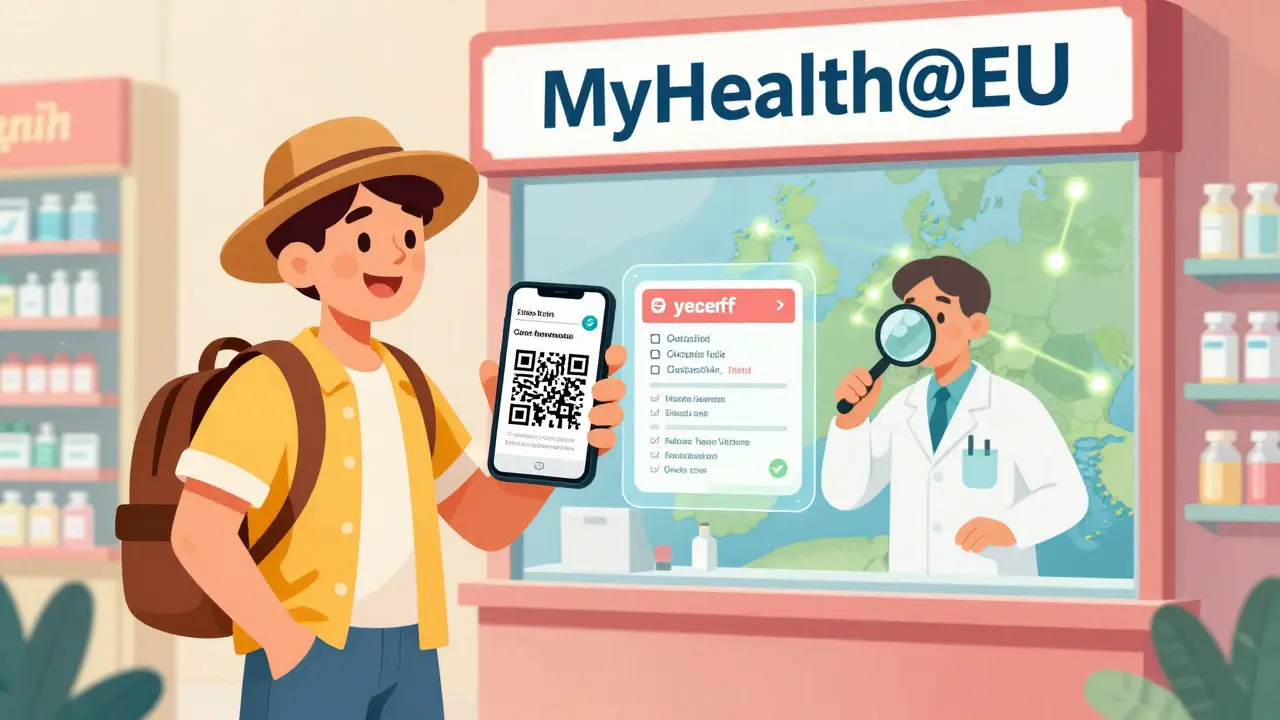
Imagine you're on vacation in Spain and your asthma inhaler runs out. Back home, your doctor prescribed it - but can you get the same generic version at a local pharmacy? In the EU, the answer is often yes. Thanks to a digital backbone built over the last decade, patients can now access generic medications across borders with just an electronic prescription. This isn’t science fiction. It’s happening right now, in real time, across 27 EU countries. But it’s not smooth sailing everywhere. Some places make it easy. Others? Not so much.
How the EU lets you get your meds across borders
The system that makes this possible is called the ePrescription and eDispensation service under the European Health Data Space (EHDS) infrastructure, branded as MyHealth@EU. It’s not a single app. It’s a secure network connecting national health systems. If you’re from Germany and you need medicine in Austria, your doctor’s digital prescription gets sent electronically to a pharmacy there. No paper. No fax. No waiting.
This isn’t new. The legal foundation came from Directive 2011/24/EU, which gave EU citizens the right to seek healthcare - including medicine - in another member state. But until recently, the practical tools were missing. Now, thanks to the eHealth Digital Service Infrastructure (eHDSI), prescriptions can travel securely. The system works with patient consent. You log into your national portal - like Germany’s eHealth card system or France’s Ameli - and approve which country can access your prescription. It’s not automatic. You have to say yes.
What’s even more useful? The Patient Summary feature gives pharmacists abroad your key health info: allergies, current meds, past conditions - all translated into their language. No more guessing if that Belgian pharmacist understands your German medical history.
Which countries are actually using this?
Not all EU countries are on the same page - literally. As of early 2026, 27 EU/EEA countries have the technical system up and running. But adoption varies wildly.
Germany, France, Austria, the Netherlands, and Portugal have fully integrated ePrescriptions into their pharmacy workflows. If you’re a Dutch patient traveling to Belgium, you can walk into a pharmacy with your phone, scan a QR code from your national health app, and walk out with your generic blood pressure meds. No questions asked.
But in countries like Ireland and Romania, the system is patchy. Irish pharmacists still can’t accept prescriptions from UK telehealth services - even if the prescription is valid in the UK. Why? Because UK prescribers aren’t registered under EU rules. So if you got your prescription from a UK online clinic while on holiday, you’re out of luck. You’ll need to see a local doctor.
Italy made headlines in February 2025 when it replaced the old paper prescription stickers with GS1 DataMatrix codes. These are scannable 2D barcodes that contain encrypted prescription data. Pharmacists scan them with a handheld reader. It’s faster, more secure, and cuts down on fraud. But it also means pharmacists need new scanners - and training. Not every pharmacy in southern Italy has them yet.
The hidden bottleneck: Pharmacists are overwhelmed
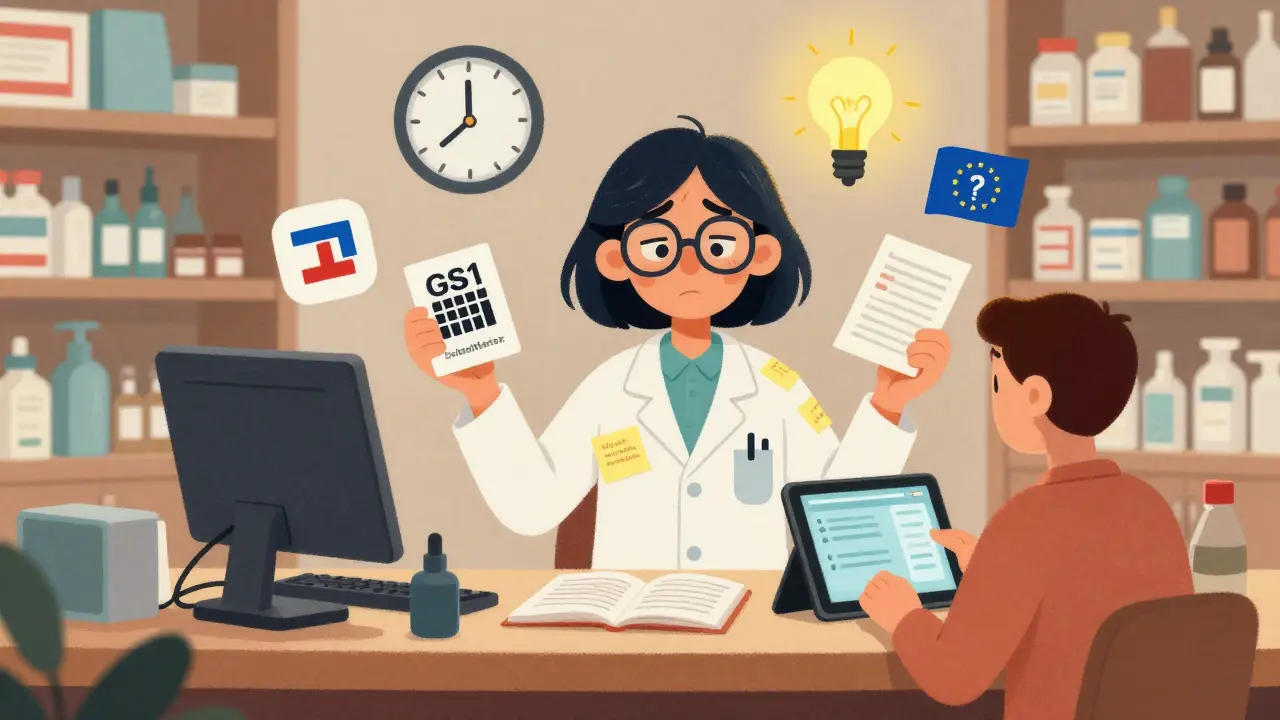
Here’s the truth no one talks about: the system works great - if the pharmacist knows how to use it.
A 2025 study by the European Association of E-Pharmacies found that pharmacists need about 40 hours of specialized training to handle cross-border prescriptions correctly. Why so much? Because each country has different rules.
- Some countries use different names for the same generic drug.
- Some have different dosages or packaging.
- Some require a physical ID check. Others don’t.
One pharmacist in northern Spain told me (in a confidential interview) that she spends 15-20 minutes per cross-border prescription verifying the prescriber’s credentials, checking the ePrescription signature, and confirming the medication matches her country’s list of approved generics. That’s 10x longer than a local prescription.
And language? Still a problem. Even with Patient Summaries, some medical terms don’t translate cleanly. A French term for “beta-blocker” might not match the exact wording used in Polish records. Pharmacists are stuck playing detective.
Why some patients still can’t get their meds
Let’s be real. The system looks perfect on paper. But real life? Messy.
Reddit threads from r/EUHealthcare are full of stories like this: a German woman on holiday in Croatia couldn’t get her diabetes medication because the generic brand wasn’t available there. The pharmacy had the active ingredient - but not the exact formulation. She ended up paying out-of-pocket for a different brand, then had to file a reimbursement claim back home.
Or take border regions. In places like the German-Czech border, people regularly cross for cheaper meds. A Czech pharmacy might stock a cheaper version of a generic statin. But if you’re from Germany, your insurance won’t cover it unless the prescription is processed through the German system. So you pay upfront, then wait weeks for reimbursement.
And then there’s awareness. Only 38% of EU citizens know they have the right to get their prescriptions filled abroad. In border towns? That number jumps to 72%. But in rural areas far from borders? Most people think cross-border pharmacy is just a myth.
What’s changing in 2025-2026
The EU isn’t sitting still. In 2025, two big changes reshaped the landscape.
First, the Critical Medicines Act requires drug manufacturers to report real-time supply and demand data across borders. If a generic drug is running low in Poland, the system flags it. Pharmacies in Hungary or Slovakia can be alerted to redirect stock. This is meant to stop shortages before they hit patients.
Second, Iceland completed its integration into the eHDSI network on August 31, 2025. Now, patients from Iceland can use their ePrescriptions in Germany, France, or Italy - and vice versa. That’s a big deal for a small country with limited pharmacy infrastructure.
But the biggest shift? The push toward a shared health data space. By 2027, the EU plans to include lab results, imaging scans, and hospital discharge summaries in the system. That means if you’re hospitalized in Sweden after a heart attack, your French doctor could pull up your full record - including your medication history - without you lifting a finger.
Who’s winning and who’s losing?
It’s not just patients. Pharmacies are caught in the middle.
Traditional brick-and-mortar pharmacies are struggling. Many don’t have the tech or staff to handle ePrescriptions. Meanwhile, e-pharmacies - like those registered with the European Association of E-Pharmacies (EAEP) - are growing fast. There are now about 120 licensed e-pharmacies across 15 EU countries, and they’re designed for this system from the ground up.
But even they’re not immune. Reimbursement rules vary. If you buy a generic drug in Belgium and want your German insurance to pay, you need to submit paperwork. Some insurers take 60 days. Others refuse outright. That’s a dealbreaker for seniors on fixed incomes.
And then there’s the regulatory patchwork. Only 8 EU countries have clear rules for how pharmacists must verify ePrescriptions. The rest? They’re guessing. That’s why patients report inconsistent experiences - even within the same country.
What you need to do to make it work
If you’re an EU citizen planning to travel and need your meds:
- Check if your country has an ePrescription system. If yes, ask your doctor to send it digitally.
- Before you leave, log into your national health portal and grant access to the country you’re visiting.
- Carry a printed copy of your prescription - just in case. Technology fails.
- Know your generic drug’s active ingredient. If the brand isn’t available, the active ingredient might still be.
- Don’t assume your UK prescription works in the EU. It doesn’t - unless it’s a paper prescription with full prescriber details.
And if you’re a pharmacist? Get trained. The EAEP offers free online modules on cross-border ePrescription handling. It’s not optional anymore - it’s the future.
What’s next?
The EU’s goal is clear: by 2030, reduce medication access disparities by 35%. That means no patient should be without their generic drug just because they crossed a border.
But it won’t happen unless governments stop treating health data like a national secret. It needs to be treated like a public utility - like electricity or water. Seamless. Reliable. Universal.
The tech is ready. The laws are mostly there. What’s missing? Political will. And patient awareness.
Right now, the system works best for people who know it exists. The next step? Making sure everyone does.
Can I get my EU prescription filled in another EU country?
Yes, if your country and the destination country are part of the ePrescription system. As of 2026, 27 EU/EEA countries support electronic prescription transfers. You need to have an ePrescription issued by a licensed provider in your home country, and you must give consent for your prescription to be accessed abroad. Always carry a paper copy as backup.
Are generic drugs the same across EU countries?
The active ingredient is legally required to be identical. But fillers, coatings, or dosing formats can differ. A generic metformin tablet from Poland might look and taste different from the one in Spain - but it will work the same. Pharmacists are trained to check for bioequivalence. If you’re switching brands, ask them to confirm the dosage matches your original.
Can I use a UK prescription in the EU?
No, not reliably. UK prescriptions are not recognized under EU ePrescription rules. Some EU pharmacies may accept paper prescriptions from UK doctors if they contain full prescriber details, but many won’t. Ireland explicitly bans it. If you’re traveling from the UK, bring enough medication for your trip - or plan to see a local doctor.
What if my medication isn’t available in the country I’m visiting?
If the exact generic brand isn’t available, the pharmacy can often substitute a different brand with the same active ingredient. But not always. Some specialized medications - like certain biologics or rare generics - may not be stocked. Always check availability before you travel. Use the MyHealth@EU portal to see which medications are listed in the destination country’s formulary.
How do I know if my country has ePrescription access?
Visit your national health ministry’s website and look for “ePrescription” or “MyHealth@EU.” Germany, France, Austria, the Netherlands, Portugal, and Italy have full systems. Countries like Ireland, Romania, and Bulgaria have partial or limited access. If you’re unsure, ask your doctor or pharmacist - they’re required to inform you of your rights under EU law.


John Cena
17 February / 2026So I just got back from a trip to Portugal and actually used this system. My asthma script from the States was accepted without a hitch. Didn't even need to show ID. Just scanned my app, pharmacist nodded, handed me the meds. Felt like magic. Wish more people knew this existed.
Still, the fact that UK prescriptions don't work here is wild. Like, we're in the same damn continent. Why is this so complicated?