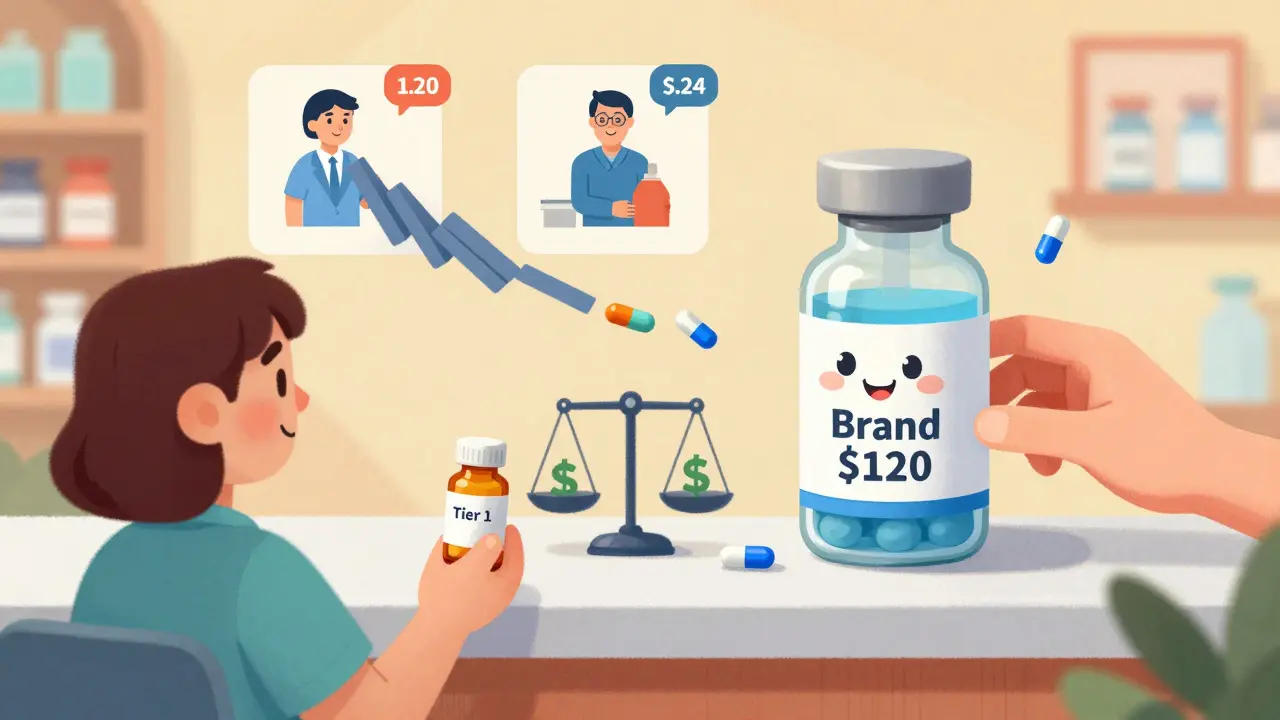
When you pick up a prescription, you might not realize the drug you’re getting wasn’t chosen just by your doctor - it was also filtered through a hidden system called a preferred generic list. These lists are the backbone of how health insurers control drug costs, and they directly impact what you pay at the pharmacy. Most people assume their doctor’s prescription is final. But in reality, insurers have already decided which versions of that drug they’ll cover cheapest - and it’s usually the generic.
How Preferred Generic Lists Work
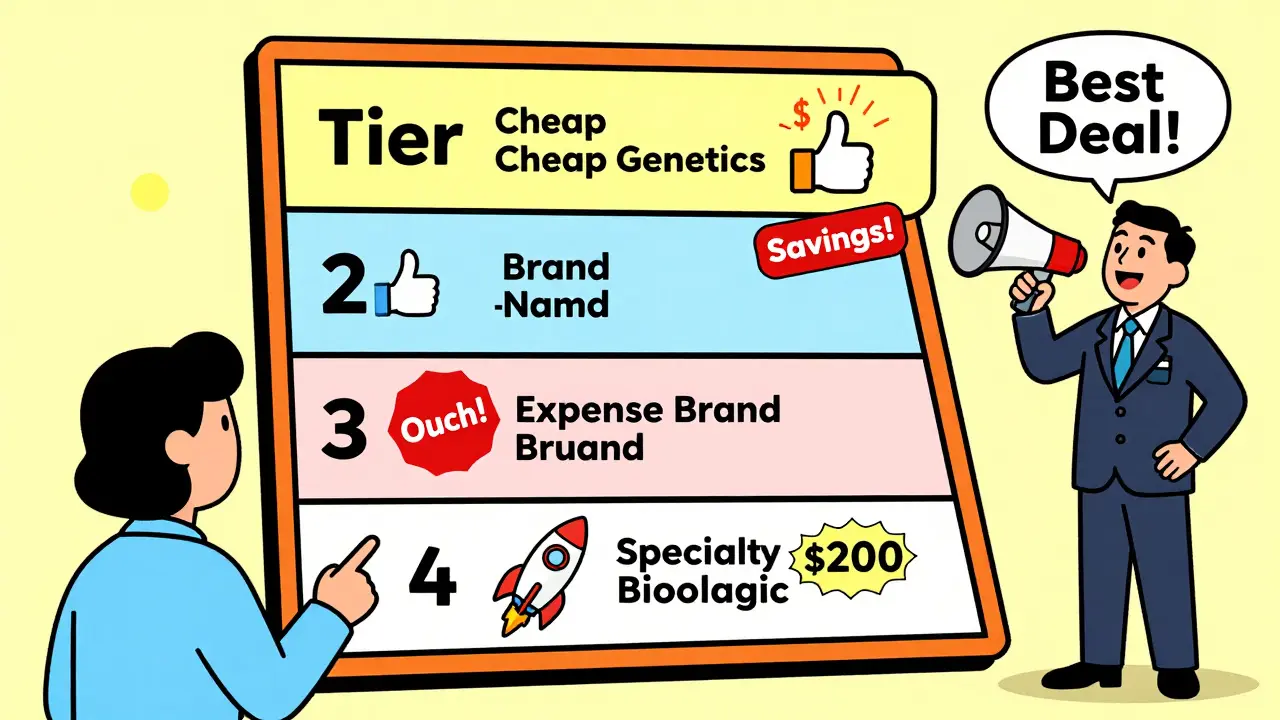
Preferred generic lists, also known as formularies, are tiered systems that sort medications based on cost and clinical value. Think of them like a menu with price tags built in. Tier 1 is where you’ll find the cheapest options: generic drugs with multiple manufacturers competing to offer the lowest price. These are the drugs insurers push you toward because they save money - often 80% to 85% less than brand-name versions, according to the FDA.Tier 2 includes brand-name drugs that still have some cost savings, or generics that aren’t as widely used. Tier 3 is for non-preferred brand-name drugs - more expensive, and you pay more. Tier 4? That’s where specialty drugs like biologics live, with copays that can hit $200 or more per month.
Almost every major insurance plan in the U.S. uses this system. Medicare Part D plans? All of them. Commercial plans? Nearly all. The goal isn’t to restrict care - it’s to steer patients toward drugs that work just as well but cost a fraction of the price. A 30-day supply of a preferred generic like lisinopril for high blood pressure might cost you $5. The brand version? $120. That’s not a typo.
Why Insurers Choose Certain Generics
Not all generics are treated the same. Insurers don’t just pick any generic - they pick the ones that offer the best deal after negotiations with manufacturers and Pharmacy Benefit Managers (PBMs). PBMs are middlemen between insurers and drugmakers. They use their buying power to get rebates and discounts. For brand-name drugs, they might get 25-30% off. For generics? They get even better deals because there are so many suppliers.When a drug has six or more generic versions on the market, prices can drop by up to 95%, according to FDA data. That’s why insurers favor generics with multiple manufacturers. It creates competition. The more companies making the same drug, the lower the price. Insurers lock in contracts with the lowest bidder - and then pass those savings to you in the form of lower copays.
But here’s the catch: sometimes, two drugs - one brand, one generic - are on the same tier. In those cases, your out-of-pocket cost might be the same ($25 copay), even though the brand costs $350 and the generic costs $200. That’s because insurers use flat copays to simplify billing. But behind the scenes, they’re still saving hundreds per prescription.
The Real Savings - And Who Benefits
The numbers speak for themselves. In 2023, generics made up 90% of all prescriptions filled in the U.S. But they accounted for only 23% of total drug spending. That’s a $1.68 trillion annual savings for the healthcare system, according to Harvard Medical School’s Dr. Aaron Kesselheim.For patients, the impact is personal. On Reddit, users share stories like u/PharmaSaver99, who dropped their monthly levothyroxine cost from $187 to $12 after switching to the generic. That’s over $2,200 saved a year. That’s not a small thing - it’s life-changing for people on fixed incomes.
Insurers benefit too. Lower drug costs mean lower premiums and fewer claims. But the biggest winners? The system as a whole. Without preferred generic lists, drug spending in the U.S. would be nearly double what it is today.
Where the System Fails
It’s not perfect. The biggest problems show up with specialty drugs - especially biologics like Humira or Enbrel. These are complex, injectable medications used for autoimmune diseases. Biosimilars (generic versions of biologics) exist and are cheaper, but insurers often don’t push them hard enough.Why? Because the original drugmakers offer co-pay assistance programs that cut your out-of-pocket to $5 or $10 a month. Biosimilar makers don’t - and insurers can’t force them to. So even though a biosimilar might cost $850 a month versus $1,200 for Humira, your actual payment might be the same - or even higher - because you lose the manufacturer’s help.
Another issue: some doctors resist switching patients to generics. For drugs like warfarin (a blood thinner), even small differences in how the body absorbs the generic version can matter. A 2022 study by the American College of Clinical Pharmacy found 23% of physicians avoid switching patients on these drugs because of stability concerns.
Then there’s step therapy - a rule that forces you to try the generic first, even if your doctor says it won’t work for you. If you fail on the generic, you can appeal. And 68% of those appeals succeed, according to Kaiser Family Foundation. But that means months of pain, delays, and frustration before you get the drug you need.
What You Can Do
You don’t have to just accept the formulary. Here’s how to take control:- Check your plan’s formulary every year during open enrollment. It changes. A drug that was Tier 1 last year might be Tier 3 this year.
- Ask your pharmacist: “Is there a preferred generic for this?” They can often swap it automatically unless your doctor wrote “dispense as written.”
- If your drug isn’t covered or is too expensive, ask your doctor to file a prior authorization or exception request. Include why the generic won’t work for you - side effects, past failures, etc.
- Use tools like GoodRx or Medicare’s Plan Finder to compare prices across pharmacies. Sometimes the cash price is lower than your copay.
- Don’t be afraid to switch plans. If your medication is on a high tier, a different insurer might cover it better.
Patients who spend just 45 minutes a year learning their formulary save 32% on medication costs on average, according to SmithRx. That’s not a lot of time for a big payoff.

The Future of Formularies
The system is changing. Starting in 2025, Medicare will require all Part D plans to place biosimilars in the same tier as their brand-name counterparts. That should push biosimilar use from 15% to 45%. Also, new rules require insurers to be more transparent - they’ll have to publicly explain why a drug is on a certain tier.Some insurers are already testing “value-based formularies.” UnitedHealthcare, for example, is starting to move drugs up or down tiers based on real-world outcomes - not just price. If a generic works better for patients with diabetes, it might get promoted. If a brand-name drug leads to more hospital visits, it might get demoted.
But there’s a dark side: “accumulator adjuster” programs. These let insurers count your drug costs toward your deductible, but not toward your out-of-pocket maximum. So if you’re using a biosimilar with no co-pay assistance, you might pay more out of pocket - and still not reach your cap. That’s a loophole that hurts patients.
The bottom line? Preferred generic lists aren’t evil. They’re a necessary tool in a broken system. They save billions and keep drugs affordable for millions. But they’re not designed with your individual needs in mind. They’re designed for efficiency - and that’s where the tension lies.
If you’re on a chronic medication, know your formulary. Ask questions. Push back when needed. And remember: the cheapest drug isn’t always the best one for you - but the one your insurer pushes might be the one that keeps you alive without bankrupting you.
Why do insurers prefer generic drugs over brand-name ones?
Insurers prefer generic drugs because they cost 80-85% less than brand-name versions, according to the FDA. When multiple manufacturers produce the same generic, competition drives prices even lower - sometimes by 95%. This lets insurers offer lower premiums and copays while still providing effective treatment. Generic drugs must meet the same FDA standards for safety and effectiveness as brand-name drugs.
Are generic drugs as effective as brand-name drugs?
Yes, for most medications. The FDA requires generics to be bioequivalent - meaning they deliver the same amount of active ingredient into your bloodstream within 80-125% of the brand-name drug’s range. Studies show 98.5% of approved generics perform the same clinically. The exception is drugs with narrow therapeutic indexes, like warfarin or levothyroxine, where even small differences can matter - but even then, most patients switch without issue.
What if my doctor says I need the brand-name drug?
Your doctor can request an exception or prior authorization. Insurers will review it, and 68% of these requests are approved, according to Kaiser Family Foundation. You’ll need documentation showing why the generic won’t work - side effects, past failures, or medical conditions. Don’t assume the answer is no - appeal if needed.
Why are biosimilars harder to get than regular generics?
Biosimilars are cheaper than brand-name biologics, but they lack the co-pay assistance programs that original manufacturers offer. If your brand-name drug has a $5 co-pay thanks to a manufacturer’s coupon, switching to a biosimilar might leave you paying $850 out of pocket - even if the list price is lower. Insurers also don’t always promote them, and some plans still place them on higher tiers.
How can I find out which drugs are on my plan’s preferred list?
Log into your insurer’s website or call customer service. Medicare beneficiaries can use the Plan Finder tool at medicare.gov. Commercial plans are often harder to navigate - many score below 3/5 in usability. If you can’t find it, ask your pharmacist. They have access to formulary databases and can tell you what’s covered and at what tier.
Can my pharmacy switch my brand-name drug to a generic without asking?
In 89% of U.S. states, pharmacists can substitute a generic for a brand-name drug unless the doctor writes “dispense as written” on the prescription. Even if you didn’t ask for it, your pharmacist may have already switched it. Check your receipt - it should say if a generic was dispensed. If you’re uncomfortable, ask to speak to the pharmacist before picking up.
Do preferred lists affect my out-of-pocket maximum?
Sometimes, no - and that’s a problem. Some insurers use “accumulator adjuster” programs that count your drug payments toward your deductible but not your out-of-pocket maximum. So even if you spend $5,000 on a biosimilar, it might not count toward the $9,200 cap. This makes it harder to reach catastrophic coverage. Check your plan documents or call your insurer to ask if they use this practice.



jenny guachamboza
21 December / 2025soooo... you're telling me the government and big pharma are teaming up to make us take cheap meds?? 😳💀 i heard they put rat poison in generics to make us dependent!!! my cousin's dog got sick after eating a pill labeled 'lisinopril' and now it barks in binary!! 🐶🤖 #conspiracy #genericgate