LAI Monitoring Checklist Calculator
Select Your Long-Acting Injectable
When you take a pill every day, it’s easy to forget - until you miss one. But with long-acting injectables (LAIs), the medication sticks around for weeks, sometimes months. That’s the whole point: no daily doses, fewer relapses, better outcomes. But here’s the problem no one talks about enough - just because the drug lasts longer doesn’t mean the risks disappear. In fact, they often hide in plain sight.
The Promise and the Blind Spot
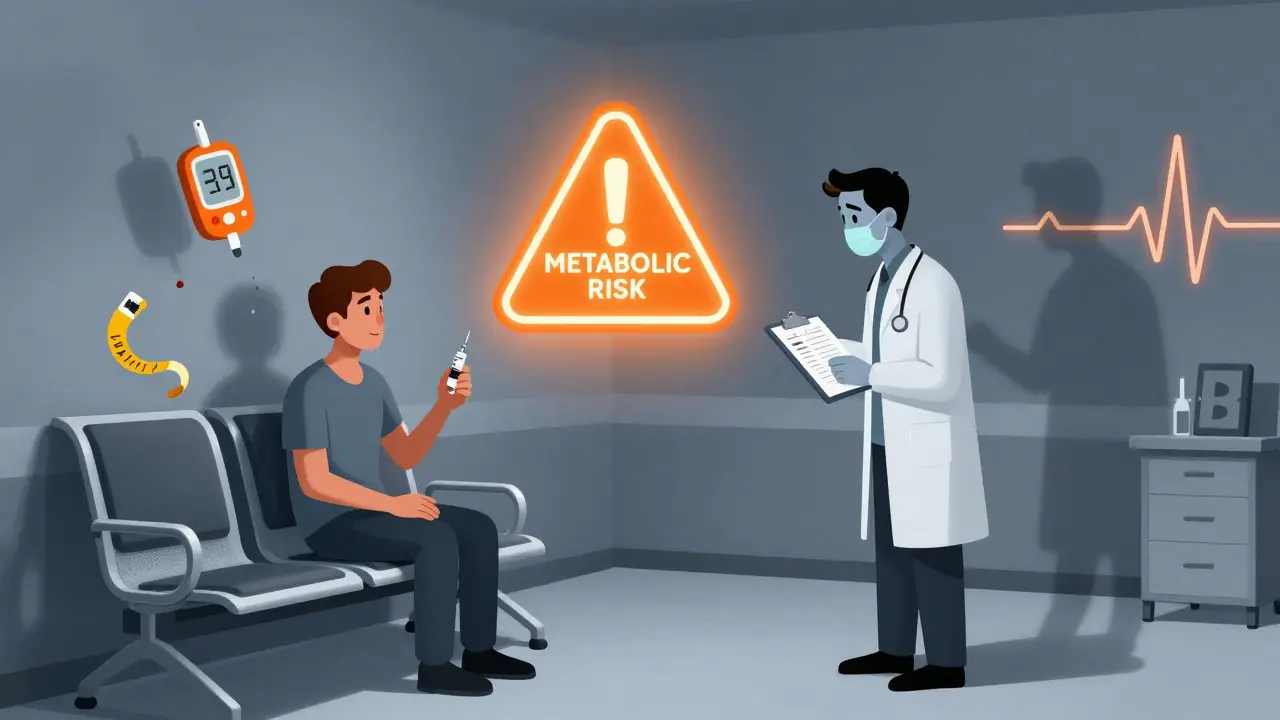
Long-acting injectables like paliperidone (Invega Sustenna), olanzapine (Zyprexa Relprevv), and aripiprazole (Aristada) are now used by over 500,000 people in the U.S. alone for schizophrenia and other serious mental illnesses. They cut relapse rates by 30-50% compared to oral meds. That’s huge. But every injection visit - every time a patient walks into a clinic - is supposed to be more than just a needle in the arm. It’s a checkpoint. A chance to catch weight gain, high blood sugar, tremors, or worse before they spiral. Yet a 2021 audit of 5,169 patients across 62 UK mental health services found something shocking: only 45% had any documented side effect assessment in the past year. That means more than half the people on these powerful, long-lasting drugs were being monitored for their mental state - but not their bodies.What Gets Missed When Monitoring Fails
Each LAI has its own risk profile. Olanzapine LAI can cause sudden, life-threatening sedation after injection. That’s why the FDA requires a mandatory 3-hour observation period. Yet, in many clinics, that rule is ignored or cut short because of time or staffing. One case report cited in a 2025 Frontiers in Psychiatry review linked a patient’s death to undetected post-injection complications. Paliperidone? It spikes prolactin levels in up to 70% of users. That means sexual dysfunction, breast swelling, missed periods, even bone loss over time. But unless someone checks a blood test, it’s invisible. A 2020 study showed 20-30% of patients on paliperidone develop metabolic syndrome - high blood pressure, belly fat, high cholesterol, insulin resistance. Left unchecked, that leads to heart disease and type 2 diabetes. Aripiprazole LAI might be gentler on the waistline, but 20-25% of users get akathisia - that agonizing inner restlessness that makes people pace, rock, or feel like they’re crawling out of their skin. Without regular use of the AIMS scale (Abnormal Involuntary Movement Scale), it’s mistaken for anxiety or worsening psychosis. And then there’s haloperidol, the old-school LAI still used in many places. It causes movement disorders in 30-50% of patients. Tremors. Muscle rigidity. Tardive dyskinesia - involuntary face or limb movements that can become permanent. Yet in a 2023 survey of 200 mental health nurses, 78% admitted they rarely did full movement disorder checks. They were too busy managing crises.The System Is Broken - And It’s Not Just About Time
"I have 15 LAI patients and 15 minutes per appointment," wrote one community psychiatrist on Reddit in early 2024. "I prioritize symptoms because that’s what gets reimbursed." That’s the real issue. Insurance pays for "mental status evaluation." It doesn’t pay for measuring waist circumference or ordering a fasting glucose test. Clinicians aren’t being careless - they’re trapped in a system that values psychiatric symptoms over physical health. The data backs this up. In the same 2021 audit:- Only 38% of patients had their weight checked
- Just 32% had blood pressure monitored
- And a terrifying 15% had any metabolic lab work done

What Good Monitoring Actually Looks Like
It’s not complicated. It’s just not happening. The National Council’s 2022 Guide to Long-Acting Medications spells it out clearly:- Before injection: Take vital signs - temperature, heart rate, blood pressure. Ask about movement issues, weight gain, sexual changes, fatigue. Use the AIMS scale every three months. More often if the patient is on haloperidol or has a history of movement disorders.
- After injection: Wait at least 30 minutes. For olanzapine LAI - 3 hours. Watch for dizziness, confusion, fainting. Document everything.
- Every six months: Fasting glucose, lipid panel, liver enzymes. Measure waist circumference. Check prolactin levels for paliperidone and risperidone users.
- Every year: Full physical exam. EKG if there’s a history of heart issues.
Change Is Coming - But Slowly
The good news? Things are shifting. In 2024, 35 Medicare Advantage plans started tying reimbursement to LAI monitoring metrics. That’s the first time insurance is paying for physical health checks as part of mental health care. Digital tools are helping too. New apps let patients log symptoms between visits - sleep changes, appetite shifts, tremors. One pilot study showed a 30% increase in early detection of side effects. And research is moving fast. A blood test that predicts who’s likely to gain weight on LAIs is in phase 2 trials and could be available by late 2025. Imagine knowing before you even start the drug whether it’s safe for your metabolism. The International Consortium on Schizophrenia Outcomes just released a 2024 consensus statement calling for global standardization of LAI monitoring by 2026. That’s the first step toward making this routine - not optional.
What Patients and Families Need to Know
If you or someone you love is on a long-acting injectable, don’t assume the doctor is checking everything. Ask:- "Have you checked my weight or waist size this visit?"
- "Did you test my blood sugar or cholesterol recently?"
- "Are you using the AIMS scale to check for movement problems?"
- "For olanzapine - did you watch me for 3 hours after the shot?"
The Bottom Line
Long-acting injectables are a breakthrough. But they’re not magic. They trade daily pills for long-term risks - risks that only show up if someone is looking for them. The science is clear. The guidelines exist. The tools are available. What’s missing is consistency. Commitment. Accountability. Until every injection visit includes a full physical check - not just a mental one - we’re not treating the whole person. We’re just giving them a longer-lasting drug and hoping for the best. That’s not care. That’s neglect dressed up as innovation.Are long-acting injectables safer than oral antipsychotics?
They’re more effective at preventing relapse - studies show 30-50% fewer hospitalizations. But they’re not safer overall. The same side effects exist - weight gain, diabetes, movement disorders - but they’re harder to catch because patients aren’t seen daily. Without structured monitoring, LAIs can lead to worse physical health outcomes over time.
How often should side effects be checked for LAIs?
At every injection visit, vital signs and mental status should be reviewed. Movement disorders (using the AIMS scale) need to be assessed every 3 months. Blood tests for glucose, lipids, and prolactin should be done every 6 months. For high-risk patients - those with obesity, diabetes, or on haloperidol - monitoring should be monthly. Olanzapine LAI requires a mandatory 3-hour observation after each dose.
Why is olanzapine LAI different from other LAIs?
Olanzapine LAI (Zyprexa Relprevv) carries a FDA black box warning for post-injection delirium/sedation syndrome - a rare but deadly reaction that can cause sudden confusion, low blood pressure, or cardiac arrest. Because of this, the FDA requires all patients to be monitored for 3 hours after injection by trained staff. No other LAI has this requirement. It’s the most tightly regulated antipsychotic injection in the U.S.
Can I refuse to be monitored after my LAI injection?
For olanzapine LAI, no - it’s legally required to stay for 3 hours. For other LAIs, you can leave after 30 minutes, but doing so puts you at risk. Side effects like dizziness, low blood pressure, or allergic reactions can happen within minutes. Clinics won’t force you to stay, but they may refuse to give you your next dose if you consistently skip monitoring. Your safety depends on it.
What should I do if my doctor never checks my weight or blood work?
Ask directly. Say: "I’m on a long-acting antipsychotic. Can we check my weight, blood sugar, and cholesterol today?" If they say no or brush you off, request a referral to a nurse practitioner or pharmacist who specializes in psychiatric medications. Many clinics now have integrated care teams. If your provider still ignores physical health, consider switching to a clinic that follows the National Council’s LAI monitoring guidelines - your long-term health depends on it.




John O'Brien
26 January / 2026Bro this is wild. I’ve been on Invega Sustenna for two years and my doctor never asked about my weight or if I was feeling restless. I just thought I was getting lazy. Turns out I had prediabetes and akathisia. They didn’t catch it until I passed out in the grocery store. Don’t let them gaslight you into thinking ‘mental health’ means ignoring your body.