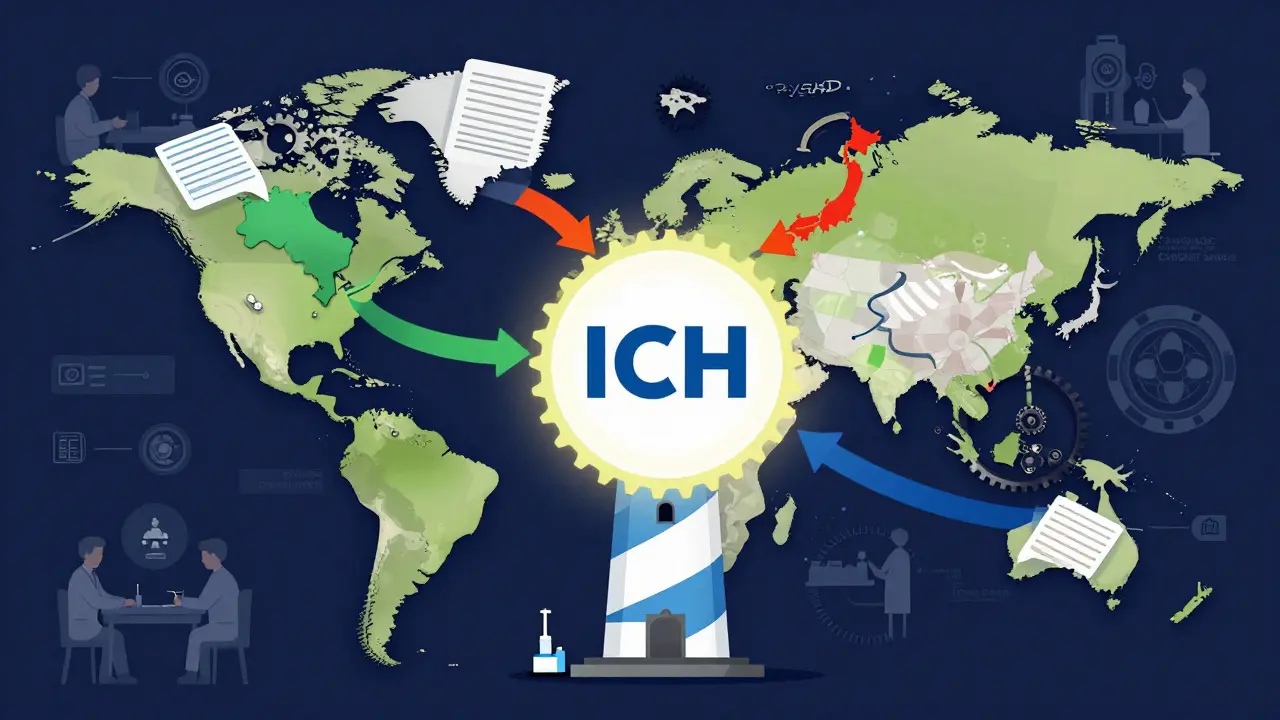
Every year, millions of people take medications that save lives. But drugs aren’t perfect. Sometimes, they cause unexpected side effects - serious ones. That’s where pharmacovigilance comes in: the science of detecting, understanding, and preventing drug-related harm. When a drug is approved in one country, it doesn’t mean it’s safe everywhere. Different regions have different rules, different systems, and different ways of tracking problems. But the world is trying to fix that. International pharmacovigilance harmonization is about making drug safety monitoring the same everywhere - not just for companies, but for patients.
Why harmonization matters
Imagine you’re a patient in Brazil, and you have a bad reaction to a medicine. Your doctor reports it. That report goes into a local database. Now imagine the same drug is used in Germany, Japan, and Canada. Each country collects its own reports. Without harmonization, those reports stay isolated. A dangerous pattern might show up in Japan, but no one in the U.S. knows about it - until someone else gets hurt. Harmonization means all these reports can talk to each other. The goal? Faster detection of hidden dangers. Fewer duplicate reports. Less wasted time and money. The FDA estimates that when countries align their systems, it cuts the time to bring a new drug to market by 15-20%. That’s not just good for companies - it’s good for patients who need new treatments faster. And it’s not just about new drugs. It’s about older ones too. A side effect that shows up years after approval can still be deadly. Harmonized systems help catch those.The backbone: ICH guidelines
The big player behind this global push is the International Council for Harmonisation (ICH). Founded in 1990 by regulators from the U.S., Europe, and Japan, ICH created a set of rules everyone could follow. Think of them as a common language for drug safety. The most important ones? The E2 series.- E2B(R3): This is the electronic format for reporting individual adverse events. Before this, companies sent reports by fax, mail, or messy PDFs. Now, it’s standardized data - structured, machine-readable, and consistent.
- E2E: This defines how companies should write Risk Management Plans (RMPs). These aren’t just paperwork. They’re action plans for what to do if a drug turns out to be riskier than expected.
- PSURs (Periodic Safety Update Reports): These are regular check-ups on a drug’s safety after it’s on the market. ICH made sure every country asks for the same data, at the same frequency.
Where the system still breaks
Even with ICH, the world isn’t fully aligned. The differences aren’t small - they’re costly. Take reporting deadlines. In the U.S., if a serious, unexpected side effect shows up, the company must report it to the FDA within 15 days. In Europe, under GVP Module V, deadlines vary. Some events need reporting in 7 days. Others? 15. Others? 30. That means a single drug with a safety issue could trigger three different reporting timelines across three regions. Then there’s what counts as “serious.” In the EU, almost all serious events get expedited reporting. In the U.S., only those the company judges as “likely related” to the drug need to be rushed. That creates confusion. One study found that 47% of companies couldn’t agree on whether an event was “expected” or not - because definitions weren’t the same. And then there’s data. The EU requires real-world data from electronic health records (EHRs) to help detect signals. The U.S. uses its Sentinel Initiative, which tracks 300 million patient records. But in many low- and middle-income countries? Only 15% of potential data sources are even usable. A 2022 survey showed that 74% of pharmacovigilance staff in these regions lack the tools to meet even basic ICH standards.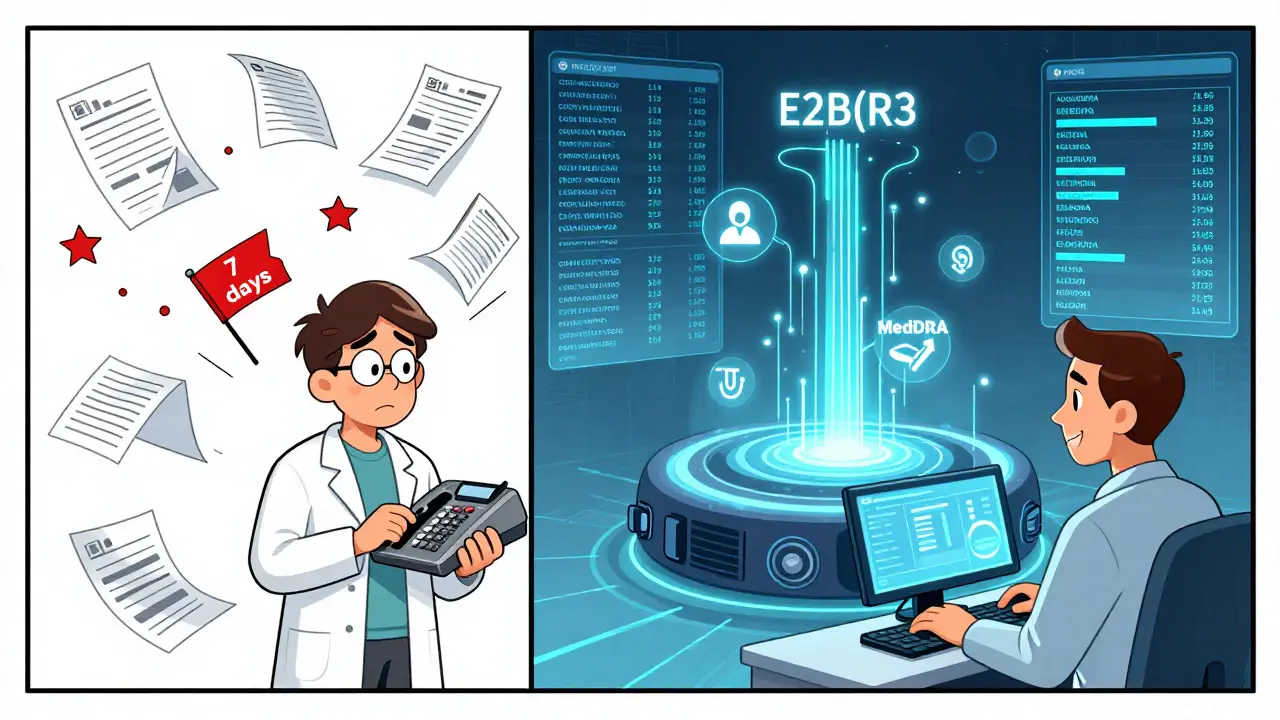
Technology is changing the game
The old way of finding drug risks? Manual review. Someone reads through hundreds of reports, looks for patterns, flags anomalies. It’s slow. It’s prone to error. Today? AI is stepping in. The EMA and FDA started using machine learning in 2022. Their systems now detect safety signals 30-40% faster than human reviewers. Japan’s PMDA launched an AI model in 2023 that cut false alarms by 25%. That’s huge. False alarms waste time and money. Real signals? They can save lives. But AI isn’t magic. It needs clean data. And that’s where harmonization matters. If one country codes a headache as “headache,” and another codes it as “cephalalgia,” the AI gets confused. That’s why MedDRA (the standard medical dictionary for adverse events) is so critical. Still, EMA found in 2023 that 18-22% of rejected reports were due to MedDRA coding errors. The next big step? Harmonizing how AI models are validated. In March 2024, ICH announced a new initiative to set global standards for AI in pharmacovigilance. If it works, by 2026, companies won’t have to train different models for different regions. One model, one validation process - global.Who’s leading? Who’s lagging?
Not all countries are in the same race. The EU, U.S., and Japan are at the front. They’ve fully adopted ICH E2B(R3). Their systems are integrated. They use real-world data. Their regulators talk to each other. The WHO’s VigiBase - the world’s largest safety database - has over 35 million reports from 134 countries. But 92% of those reports come from just 15 high-income nations. China has made huge progress since 2020. But it still requires local reporting within 15 days - even if the same report was sent to the FDA. That’s duplication. Canada aligns closely with ICH but keeps its own 30-day rule for serious events. Brazil and South Africa? They’re still struggling to digitize even basic reporting. This isn’t just about fairness. It’s about safety. A drug that causes liver damage in India might never show up in U.S. databases - because the reports aren’t being made or sent. That’s why the WHO’s Global Smart Pharmacovigilance Strategy, currently being finalized after a 2024 meeting in New Delhi, is so important. It aims to set common data standards for 150 countries by 2027.


Ernie Simsek
11 February / 2026This is wild 🤯 I work in pharma and let me tell you - we spend HALF our time just translating reports into 5 different formats. ICH E2B(R3) was a game-changer, but even then, the EU and FDA still argue over whether a 'mild rash' counts as 'serious'. We had a case where the same patient reaction got flagged as urgent in Germany but ignored in the US for 3 months. It’s insane.