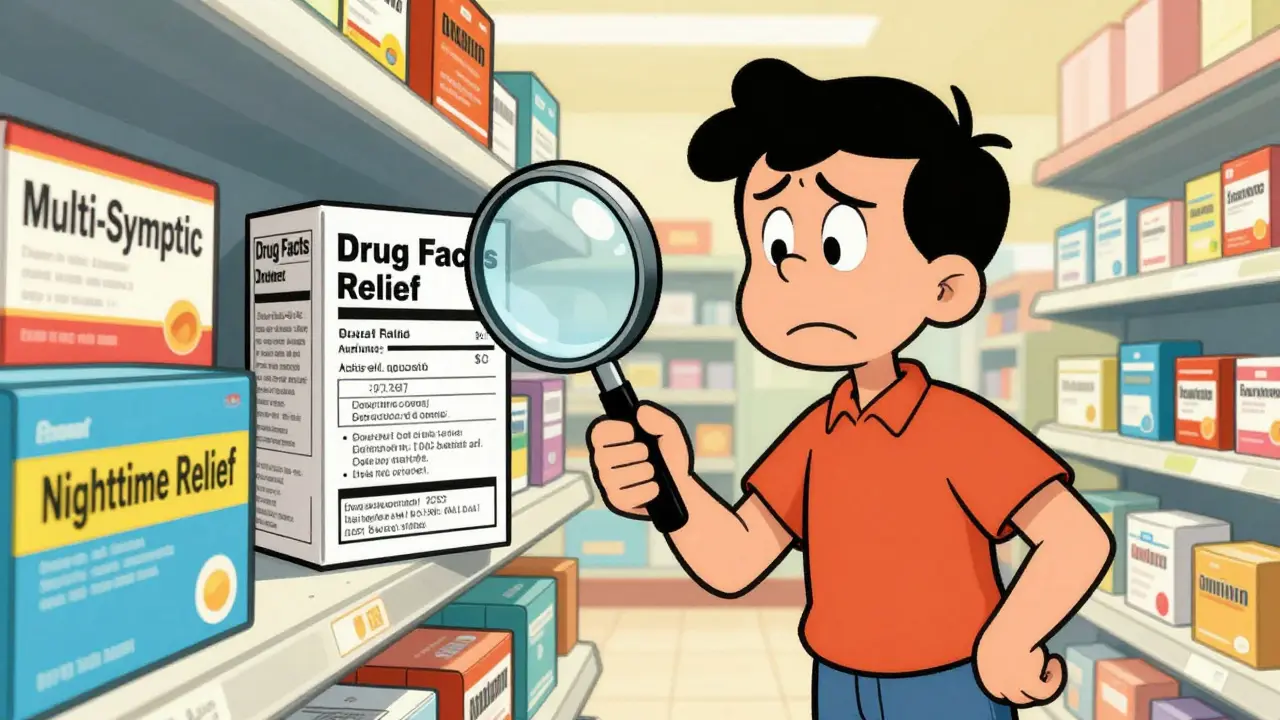
You're standing in the pharmacy aisle, staring at a wall of colorful boxes. One says "Multi-Symptom Cold & Flu," another says "Nighttime Relief," and a third is just a generic "Pain Reliever." To the naked eye, they look like different products. But if you look closer at the labels, you'll find they often contain the exact same chemical. This is where things get dangerous. Many people accidentally overdose because they don't realize that two different brand-name products are actually delivering the same active ingredients to their system.
Understanding the "Drug Facts" label isn't just about being a cautious shopper; it's about preventing serious medical emergencies. A staggering 70% of medication errors with over-the-counter (OTC) drugs happen because people skip the active ingredient list, according to the FDA. Whether you're buying medicine for yourself or your kids, knowing how to spot the real"workhorse" in the pill can save you a trip to the ER.
| Active Ingredient | Common Brand Names | Primary Purpose | Typical OTC Dose |
|---|---|---|---|
| Acetaminophen | Tylenol, TheraFlu | Pain & Fever | 325mg - 500mg |
| Ibuprofen | Advil, Motrin | Inflammation & Pain | 200mg |
| Diphenhydramine HCl | Benadryl | Allergies & Sleep | 25mg - 50mg |
| Guaifenesin | Mucinex | Chest Congestion | Varies by form |
What Exactly is an Active Ingredient?
In the world of pharmacy, Active Ingredients is the specific chemical compound in a medication that produces the therapeutic effect . Everything else in the pill-the binders, the dyes, the flavorings-are "inactive ingredients." They make the pill hold its shape or taste like cherry, but they don't actually treat your headache or cough.
The FDA (Food and Drug Administration) mandates a standardized "Drug Facts" label to stop consumers from guessing. This system was put in place back in 1999 after a study found that nearly 80% of people couldn't tell what was actually inside their medicine. Now, the law requires the active ingredient to be listed first, using the generic name and the exact amount per dose (like "acetaminophen 325 mg per tablet").
The Danger of "Double-Dosing"
The biggest risk for shoppers is the "combination product." Imagine you take a dose of Tylenol for a fever, and then you take a multi-symptom cold medicine to stop a runny nose. If that cold medicine also contains acetaminophen (the active ingredient in Tylenol), you've just doubled your dose without knowing it. This is how liver toxicity happens.
Real-world stories on forums like Reddit are full of people who ended up in the hospital because they didn't realize their "Nighttime Relief" and their "Pain Reliever" were the same thing. Remember, different brands do NOT mean different ingredients. Tylenol, Excedrin, and TheraFlu can all center around the same active compound. If you see the same chemical name on two different boxes, do not take them at the same time.
How to Read a Label Like a Pro
Don't just glance at the front of the box; that's where the marketing lives. To stay safe, follow this four-step check every time you shop:
- Find the "Active Ingredient" Header: This is always the very first section of the Drug Facts label. If it's not there, the product may not be a regulated drug.
- Identify the Chemical: Look for the generic name (e.g., Naproxen Sodium instead of Aleve). If you are allergic to a specific drug, this is the only name that matters.
- Check the Dosage: Look at the milligrams (mg) per dose. For example, OTC ibuprofen is usually limited to 200 mg per tablet, while prescription versions can be 800 mg.
- Cross-Reference: If you are taking multiple meds, write down the active ingredients from each. If you see any repeats, stop and call your pharmacist.
Research from Nationwide Children's Hospital suggests that spending just 45 seconds reading this label can reduce medication errors by 68%. It's a tiny time investment for a huge safety payoff.
Active vs. Inactive Ingredients: Why Both Matter
While the active ingredient does the healing, the inactive ingredients can cause their own problems. These are the fillers, colors, and preservatives. For most people, they're harmless. However, if you or your child have specific allergies, these are the hidden triggers.
For instance, some parents have reported allergic reactions (like hives) because they didn't check the inactive list for Red Dye #40. While the FDA requires active ingredients to be listed by weight and concentration, inactive ingredients are usually listed at the end. If you have a known allergy to a dye or a specific sweetener, always scroll to the bottom of the label.
Understanding OTC Monographs
You might wonder why almost every brand of "Extra Strength" pain relief has the same amount of medicine. That's because of the OTC Monograph system. Think of a monograph as a "recipe book" approved by the government. It tells manufacturers exactly what active ingredients they can use, what the safe concentrations are, and what they are allowed to claim the drug treats.
For example, the internal analgesic monograph sets a strict ceiling for acetaminophen: adults should not exceed 4,000 mg in a 24-hour period. If a company wants to sell a product that stays within these guidelines, they don't need a new FDA approval for every single brand-they just follow the monograph. This is why generic store brands are often identical to name brands; they are following the exact same approved recipe.

The Future of Shopping: Digital Labels
Reading tiny print on a glossy box is a pain. To fix this, the FDA is moving toward digital labeling. By 2026, many medications will likely feature QR codes. Instead of squinting at the box, you'll scan the code with your phone to get a full, searchable list of ingredients and warnings. Early tests show this improves comprehension by nearly 50%, especially for people who struggle with health literacy or have vision impairment.
Why is the active ingredient listed as a generic name instead of the brand name?
The FDA requires generic names (like ibuprofen instead of Advil) because brand names are marketing terms. Generic names are universal scientific identifiers, ensuring that doctors, pharmacists, and patients all know exactly which chemical is being used regardless of who manufactured the pill.
Can a drug have more than one active ingredient?
Yes. Multi-symptom medications often combine several active ingredients. For example, a cold medicine might contain acetaminophen for pain, dextromethorphan for a cough, and phenylephrine for congestion. These must be listed separately with their individual concentrations on the label.
What should I do if I accidentally took two different products with the same active ingredient?
First, stop taking all medications. Then, check the total amount of the active ingredient you consumed. If you have exceeded the maximum daily dose (especially with acetaminophen), contact a poison control center or go to the emergency room immediately, even if you feel fine, as some toxicity symptoms don't appear right away.
Are OTC active ingredients different from prescription ones?
Often, they are the same chemical but in different concentrations. For instance, OTC ibuprofen is typically capped at 200 mg per tablet. A doctor might prescribe a higher dose, such as 800 mg, for more severe inflammation. The active ingredient is the same, but the strength is increased for medical supervision.
Do inactive ingredients have any purpose?
Yes. Inactive ingredients serve several roles: they provide the structure of the tablet (binders), mask the bitter taste of the chemical (flavorings), and keep the medication stable on the shelf (preservatives). While they don't treat the illness, they make the medicine usable and palatable.
Next Steps for Safe Shopping
If you're managing a medicine cabinet for a whole family, start by auditing your current stock. Group your medicines by their active ingredients rather than by brand. Put all the "acetaminophen" products in one spot and all the "ibuprofen" products in another. This visual cue reminds you that you're choosing between types of medicine, not just brands.
For those with high blood pressure or chronic conditions, be extra careful with multi-symptom meds. Ingredients like phenylephrine can interact with blood pressure medication. When in doubt, don't guess-ask the pharmacist at the counter. They are the best resource for doing a quick "cross-check" of your active ingredients before you head to the checkout line.