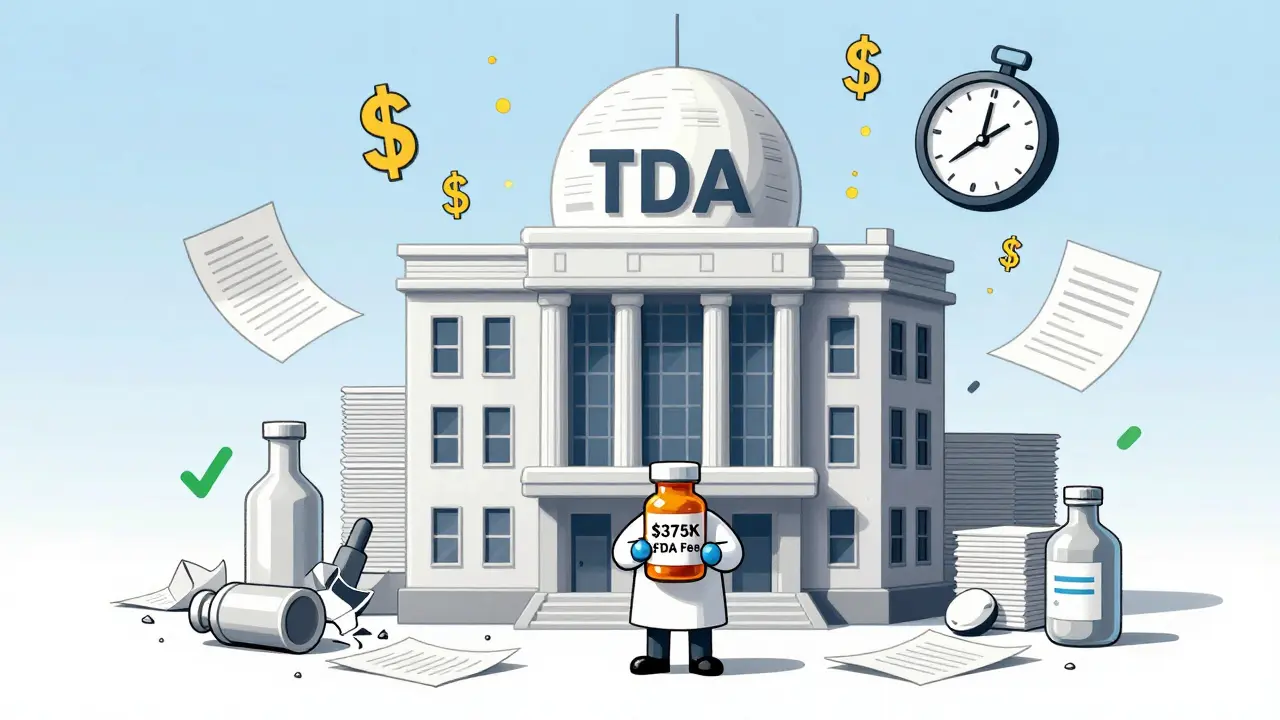
For most people, generic drugs are the reason they can afford their prescriptions. But behind every cheap pill is a long, expensive, and often frustrating journey through the FDA’s approval system. The cost to get a generic drug approved isn’t just a number on a balance sheet-it directly affects how much you pay at the pharmacy. And right now, that system is broken for the most complex generics.
What You’re Really Paying for When You Buy a Generic
A generic drug might cost $5 instead of $300, but getting it to market can cost a company over $375,000 just in FDA fees. That’s not a typo. Under GDUFA III, the current user fee program, manufacturers pay $136,485 per product application, plus $238,055 in facility fees, and other hidden costs like testing, documentation, and legal prep. For a small generic company, that’s more than half their annual budget for one drug. And if the FDA sends back a Complete Response Letter (CRL), which happens in 35% of cases, they’re looking at another $2-5 million and 8-12 more months just to try again.The irony? The FDA’s goal was to speed things up. When GDUFA launched in 2013, it promised faster reviews, more transparency, and lower drug prices. It worked-for simple generics. But for complex drugs-things like inhalers, injectables, or topical creams that mimic brand-name products in tricky ways-the system has become a bottleneck.
The 2015 Policy That Slowed Down Generics
In 2015, the FDA changed how it reviewed complex generics. Before that, if a company submitted a formulation that didn’t match the brand drug exactly, the FDA would tell them: "Your active ingredient concentration is 5% off," or "Your particle size distribution doesn’t match." That feedback let companies fix the problem in one try.After 2015, the FDA stopped giving those specifics. They just said: "Not equivalent." No details. No guidance. That forced manufacturers into guesswork. One company told RAPS in 2024 they spent $8.7 million and three failed reformulations on a single nasal spray because they had no idea what the FDA wanted. That’s not innovation-that’s trial and error at taxpayer expense.
Result? Approval timelines for complex generics jumped from 10 months to over 14 months on average. First-cycle approval rates dropped to 42%, compared to 65% for simple generics. And patients? They kept paying brand prices for years longer than they should have.
Brand vs. Generic: The Real Cost Difference
Let’s put this in perspective. A brand-name drug application (NDA) costs $3.685 million to submit to the FDA. A generic? Around $375,000. That’s a 90% cost difference. Yet the FDA spends just as much time reviewing them. Why? Because complex generics are scientifically harder to prove equivalent. But instead of helping companies navigate that complexity, the FDA made it harder.Here’s the math: In 2024, generics made up 90.3% of all prescriptions filled in the U.S.-over 4.3 billion pills. But they accounted for only 12.2% of total drug spending. That’s $467 billion in savings. Meanwhile, brand-name drugs, which make up less than 10% of prescriptions, cost $700 billion. That’s not a market failure. That’s a regulatory failure.
Why? Because 83% of brand-name drugs still have no generic competition five years after their patents expire. That’s not because no one wants to make a generic. It’s because the FDA’s process is too slow, too opaque, and too expensive for companies to risk.
Who’s Getting Hurt?
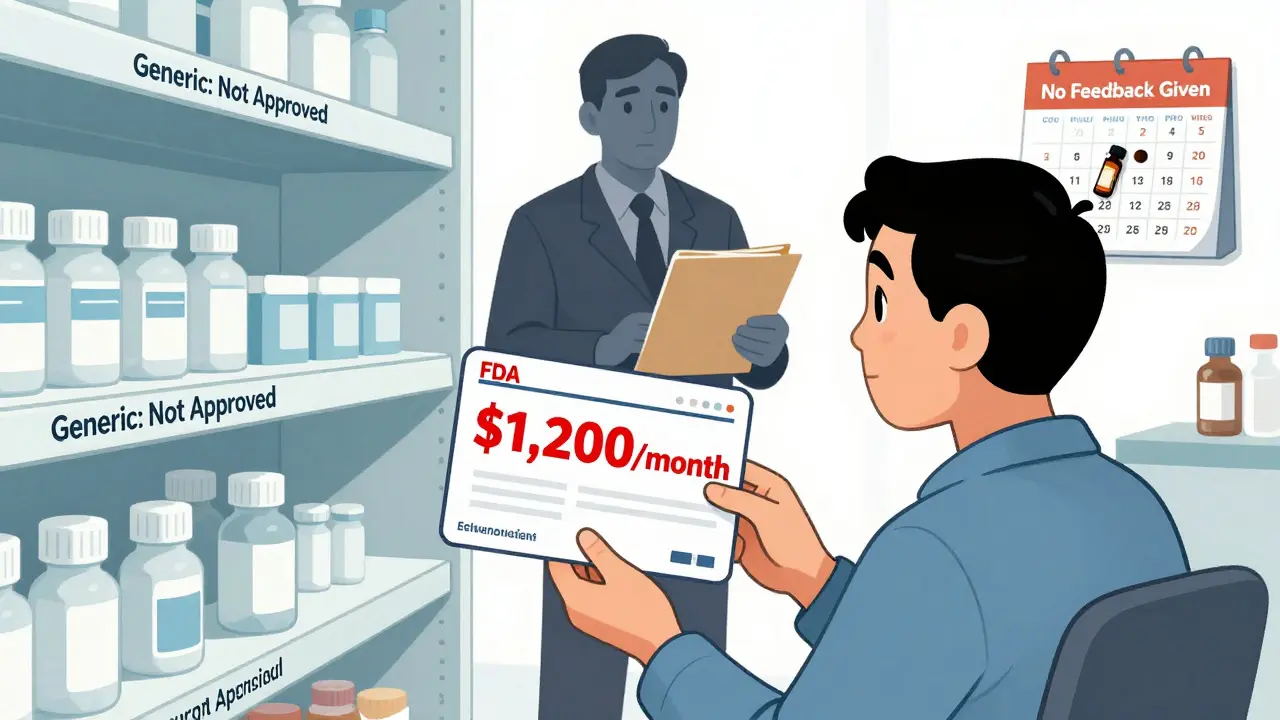
It’s not just the manufacturers. It’s the patients.Between 2016 and 2020, generic versions of testosterone replacement therapy were delayed by 4.7 years. During that time, patients paid up to 300% more for the brand. On Reddit, a September 2025 thread titled "Generic approval delays cost me $1,200/month" had over 140 comments from people who couldn’t afford their meds because generics weren’t available. One man said he skipped his glipizide dose for two months because the generic hadn’t cleared the FDA. He ended up in the ER.
On the other side, pharmacists defend the current system. One New York pharmacist said the extra scrutiny prevented another valsartan recall, which affected 22 million people in 2022. That’s valid. Safety matters. But safety shouldn’t mean silence. If the FDA can’t tell manufacturers what’s wrong, they’re not ensuring safety-they’re just delaying it.
What’s Being Done to Fix It?
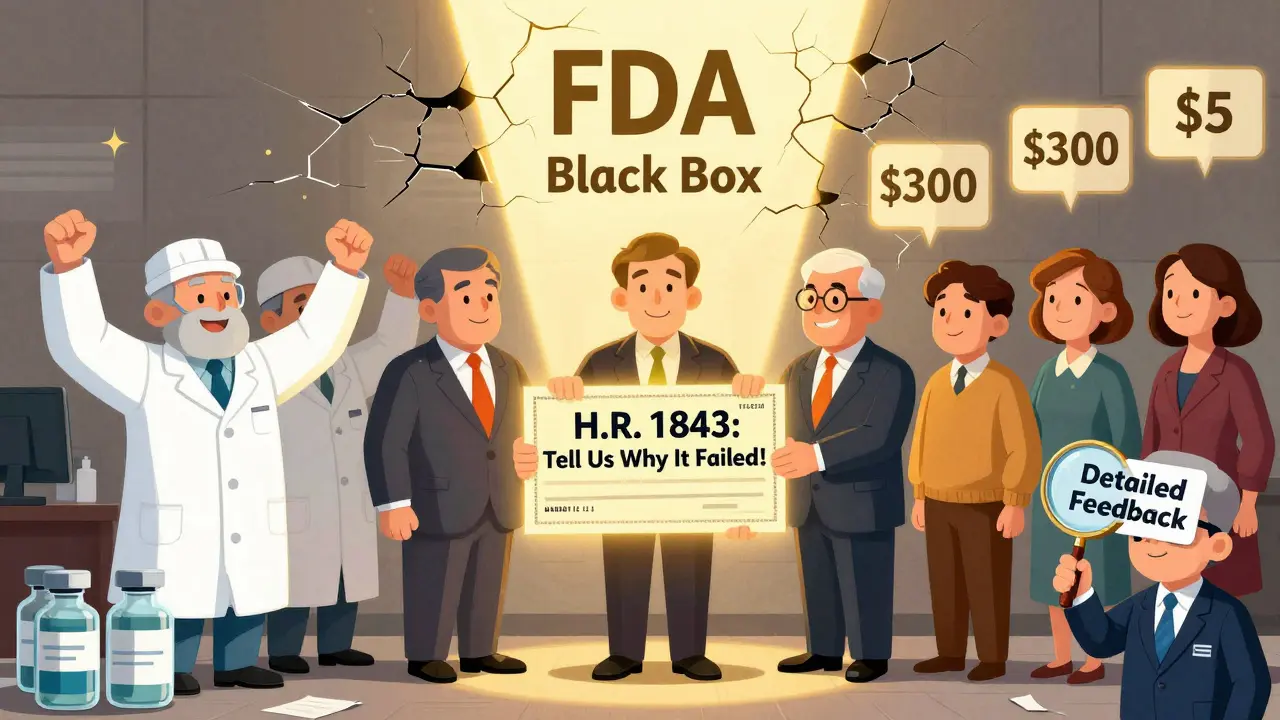
In September 2025, Rep. Neal Dunn and Rep. Kevin Mullin introduced H.R. 1843, the Increasing Transparency in Generic Drug Applications Act. It’s simple: require the FDA to give detailed feedback on formulation issues during reviews. The Congressional Budget Office estimates this could cut approval times for complex generics by 18-24 months. That means 12-15 more complex generics hit the market each year, saving $1.8-2.3 billion annually.The bill has 72 co-sponsors-bipartisan support. That’s rare these days. The FDA, however, is hesitant. In July 2025, their Office of Generic Drugs warned that restoring feedback without more staff could hurt review quality. They’re stuck between speed and safety.
But here’s the truth: they already have the staff. GDUFA III brought in $613 million in 2025 just from user fees. That’s more than enough to hire 200 more reviewers. The problem isn’t funding. It’s priorities.
What Can Manufacturers Do Right Now?
If you’re a generic drug maker, here’s what actually works:- Use Type II meetings with the FDA early-78% of successful applicants do. These pre-submission meetings cut review time by over 3 months.
- Submit complete, clean applications. The average ANDA is now 150,000-200,000 pages long. That’s triple the size of a 2013 submission. Don’t cut corners on documentation.
- Target simple generics first. They have a 65% first-cycle approval rate. Build cash flow before tackling complex products.
- Apply for small business waivers if you have under 1,000 employees. You can get 75% off product fees.
And if you’re waiting for a complex generic? Be patient. But also be loud. Contact your rep. Ask why the FDA won’t give feedback. Ask why the same drug that took 3 years to approve in Europe cleared the FDA in 18 months in Canada. The system isn’t broken because of science. It’s broken because of bureaucracy.
The Bigger Picture: Why This Matters
The U.S. spends more on drugs than any other country. And generics are the only thing keeping that number from exploding. In 2024, Medicare Part D enrollees saved $1,152 per person thanks to generics. That’s not a bonus-it’s a lifeline.But if the FDA keeps refusing to give clear feedback, more companies will walk away from complex generics. That means fewer options for patients with diabetes, asthma, heart disease, and cancer. It means brand-name drugs stay on the market longer, charging inflated prices. It means the savings from generics-$467 billion in 2024-start shrinking.
The FDA’s job isn’t to be a gatekeeper. It’s to be a facilitator. If they want to reduce drug costs, they need to stop making approval harder than it needs to be. The science is there. The demand is there. The savings are there. All they’re missing is the will to change.
How much does it cost to get a generic drug approved by the FDA?
The total cost for a single generic drug application under GDUFA III averages around $375,000. This includes a $136,485 product fee, a $238,055 facility fee, and additional costs for testing, documentation, and legal compliance. For complex generics, development and reformulation costs can push total expenses to $8-15 million before approval.
Why are generic drug approvals taking longer now?
Since 2015, the FDA stopped providing specific feedback on formulation differences for complex generics. Without knowing what exactly failed, manufacturers must guess and reformulate multiple times. This trial-and-error approach adds 2-3 years to development. Average review times rose from 10 months to 11.2 months for standard applications and over 14 months for complex ones.
What’s the difference between brand-name and generic drug approval costs?
A brand-name drug (NDA) costs $3.685 million to submit to the FDA, while a generic (ANDA) costs around $375,000. But the FDA spends similar review time on both. The problem isn’t cost-it’s complexity. Complex generics require more scientific work, but the FDA doesn’t give enough guidance to make that work efficient.
How do FDA delays affect patients?
Delays mean patients pay more. For example, generic versions of testosterone therapy were delayed by 4.7 years, forcing patients to pay 300% more for the brand. On Reddit, patients reported paying $1,200/month out-of-pocket for drugs like apixaban and glipizide because generics weren’t approved. These delays directly impact health outcomes and financial stability.
Is there legislation to fix this?
Yes. H.R. 1843, introduced in September 2025, would require the FDA to provide detailed feedback on formulation issues during generic drug reviews. The Congressional Budget Office estimates this could accelerate approval of 12-15 complex generics per year, saving $1.8-2.3 billion annually. The bill has 72 bipartisan co-sponsors and is scheduled for committee review in December 2025.
What Comes Next?
The FDA is already preparing for GDUFA IV, which will cover 2028-2032. Industry groups are pushing for a 3-5% annual fee increase to hire more reviewers. The agency says it needs the money. But here’s the catch: they already have the money. GDUFA III brought in over $600 million in 2025. The issue isn’t funding-it’s transparency.If the FDA wants to keep its promise of lowering drug costs, it needs to stop hiding behind "quality concerns." It needs to give manufacturers the information they need to fix problems on the first try. That’s not just good policy. It’s good medicine.



Christina Widodo
11 January / 2026So let me get this straight-we spend $375k just to get a generic approved, but the FDA won’t tell companies what’s wrong with their application? That’s like paying a mechanic $500 to fix your car and they just hand you back the keys saying ‘it’s broken’ and walk away. No wonder people are skipping doses. This isn’t regulation, it’s performance art.