
When you’re on antibiotics, your gut knows it. The good bacteria, the ones that help with digestion, immunity, and even mood, get wiped out along with the bad ones. That’s why so many people end up with diarrhea, bloating, or yeast infections after a course of antibiotics. But taking probiotics can help - if you do it right. The biggest mistake? Taking them at the same time as your antibiotic. That’s like sending in reinforcements only to have them shot before they reach the battlefield.
Why Timing Matters More Than You Think
Antibiotics don’t pick and choose. They kill bacteria - both the harmful ones causing your infection and the helpful ones living in your gut. Probiotics are live bacteria. If you swallow them right after your antibiotic pill, the antibiotic will likely kill them before they even get a chance to settle in. Studies show this reduces probiotic survival by 78% to 92%. That’s not just a small loss - it’s almost total failure. The fix? Space them out. The gold standard, backed by clinical trials and major health organizations, is to take probiotics at least two hours before or after your antibiotic dose. This gives the antibiotic time to move through your digestive system and clear out of your gut before the probiotics arrive. It’s not about waiting all day - just two hours is enough to make a big difference.Which Probiotics Work Best?
Not all probiotics are created equal. Some strains survive antibiotics better than others. The two most studied and effective strains are:- Lactobacillus rhamnosus GG (LGG) - Proven to reduce antibiotic-associated diarrhea by up to 47%. Dose: 10-20 billion CFUs per day.
- Saccharomyces boulardii CNCM I-745 - A yeast, not a bacteria. This means antibiotics don’t touch it. It can be taken at the same time as your antibiotic without losing effectiveness. Reduces diarrhea risk by 52% at 20 billion CFUs per day.
How Much Should You Take?
Dose matters. Too little, and you won’t see results. Too much, and you might just waste money. Here’s what the science says:- Mild cases (short course, no diarrhea): 5-10 billion CFUs per day
- Diarrhea or moderate gut upset: 10-20 billion CFUs per day
- Long-term antibiotics (over 14 days) or pre-existing gut issues: 20-40 billion CFUs per day

When to Start - And When to Stop
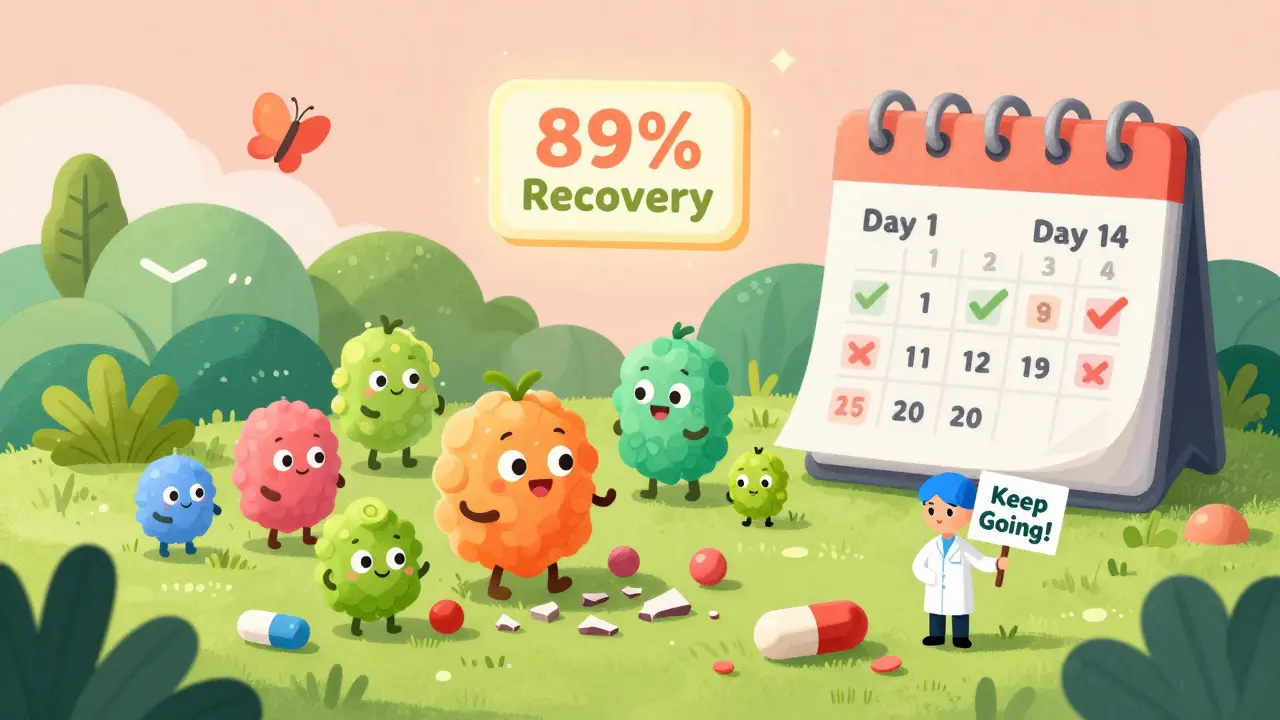
Start as soon as possible. Don’t wait until you feel sick. Research shows starting within 48 hours of your first antibiotic dose cuts the risk of diarrhea by 71%. The sooner you begin, the better your gut can hold onto what’s left of its good bacteria. And don’t stop when your antibiotic runs out. Your gut needs time to recover. Experts recommend continuing probiotics for 7 to 14 days after your last antibiotic pill. A 2024 study from Cymbiotika found that people who stuck with probiotics for two weeks after antibiotics had 89% microbiome recovery - compared to just 63% in those who stopped early.What About Saccharomyces boulardii? Can You Take It With Antibiotics?
Yes. And you should. Because Saccharomyces boulardii is a yeast, not a bacterium, antibiotics don’t affect it. It’s the only probiotic that can be taken at the same time as your antibiotic without losing effectiveness. That makes it ideal for people who struggle with timing or forget doses. It’s also the only probiotic proven to reduce the risk of Clostridium difficile infection (CDI), a dangerous and sometimes life-threatening complication of antibiotic use. For high-risk patients - like those on long-term antibiotics or with prior CDI - S. boulardii is often the first recommendation.Real-Life Scheduling Examples
Let’s say you’re on amoxicillin twice a day - 8 a.m. and 8 p.m.- Option 1 (bacterial probiotic): Take your probiotic at 6 a.m. and 6 p.m. That’s two hours before each antibiotic.
- Option 2 (Saccharomyces boulardii): Take it at 8 a.m. and 8 p.m. - same time as your antibiotic. No waiting needed.
What If You Forget?
Missing a dose isn’t the end of the world, but it does hurt results. A 2023 study from Seed showed skipping probiotic doses reduces effectiveness by 37%. If you forget and take your probiotic within an hour of your antibiotic, don’t panic. Just wait until your next scheduled dose and go back on track. Don’t double up. For people on complex medication schedules - multiple pills, vitamins, supplements - the 2-hour rule can be hard to stick to. That’s why many doctors now recommend Saccharomyces boulardii for these patients. One less thing to remember.What Doesn’t Work
- Taking probiotics and antibiotics together without spacing - kills the probiotics.
- Waiting until after antibiotics to start - cuts effectiveness by 32%.
- Using probiotics with no strain listed on the label - you’re guessing.
- Assuming more strains = better results - science says no.
- Stopping probiotics as soon as you feel better - you need to rebuild, not just relieve.
What’s Next?
Science is moving fast. Companies are now developing time-release capsules and acid-resistant coatings that might one day let probiotics survive antibiotics without spacing. But as of late 2024, none have been proven in large-scale trials. The 2-hour rule is still the standard - backed by 27 out of 31 major medical institutions. For now, the best approach is simple: choose a proven strain, take the right dose, space it out, and keep going after your antibiotics are done. It’s not magic. But it’s science that works.Can I take probiotics at the same time as my antibiotic?
Only if it’s Saccharomyces boulardii - a yeast-based probiotic. All bacterial probiotics (like Lactobacillus and Bifidobacterium) must be taken at least two hours before or after your antibiotic. Taking them together kills up to 92% of the beneficial bacteria before they can do any good.
How long should I keep taking probiotics after finishing antibiotics?
Continue for 7 to 14 days after your last antibiotic dose. Your gut microbiome needs time to recover. Stopping too soon means you lose most of the benefit. Studies show people who stick with probiotics for two weeks after antibiotics have nearly 30% better microbiome recovery than those who quit early.
Do I need a high CFU count?
Yes - but not all high counts are equal. For most people, 10-20 billion CFUs per day is enough. If you’re on antibiotics longer than two weeks, or have had diarrhea before, go for 20-40 billion. But make sure the product lists the actual strain - Lactobacillus rhamnosus GG or Saccharomyces boulardii CNCM I-745. Without that, high CFUs mean nothing.
Are multi-strain probiotics better?
No. A 2022 Cochrane Review of over 1,400 patients found no significant difference between single-strain and multi-strain probiotics for preventing antibiotic-associated diarrhea. More strains don’t mean better results. Stick with proven strains like LGG or S. boulardii - even if it’s just one.
What if I can’t remember to space them two hours apart?
Switch to Saccharomyces boulardii. Since it’s a yeast, it’s not affected by antibiotics. You can take it at the same time as your pill - no timing needed. It’s the easiest way to stay consistent, especially if you’re juggling multiple medications.
Can probiotics cause side effects during antibiotics?
Rarely. Some people report mild bloating or gas at first, especially with high doses. This usually fades in a few days. If you have a weakened immune system or a central line, talk to your doctor first - yeast probiotics like S. boulardii can, in very rare cases, cause infection in high-risk patients.




Pawan Chaudhary
16 December / 2025This is such a helpful guide! I was taking probiotics with my antibiotics and wondered why I still felt awful. Two-hour gap? Easy peasy. Started LGG yesterday and already feel less bloated. Thanks for making it simple!