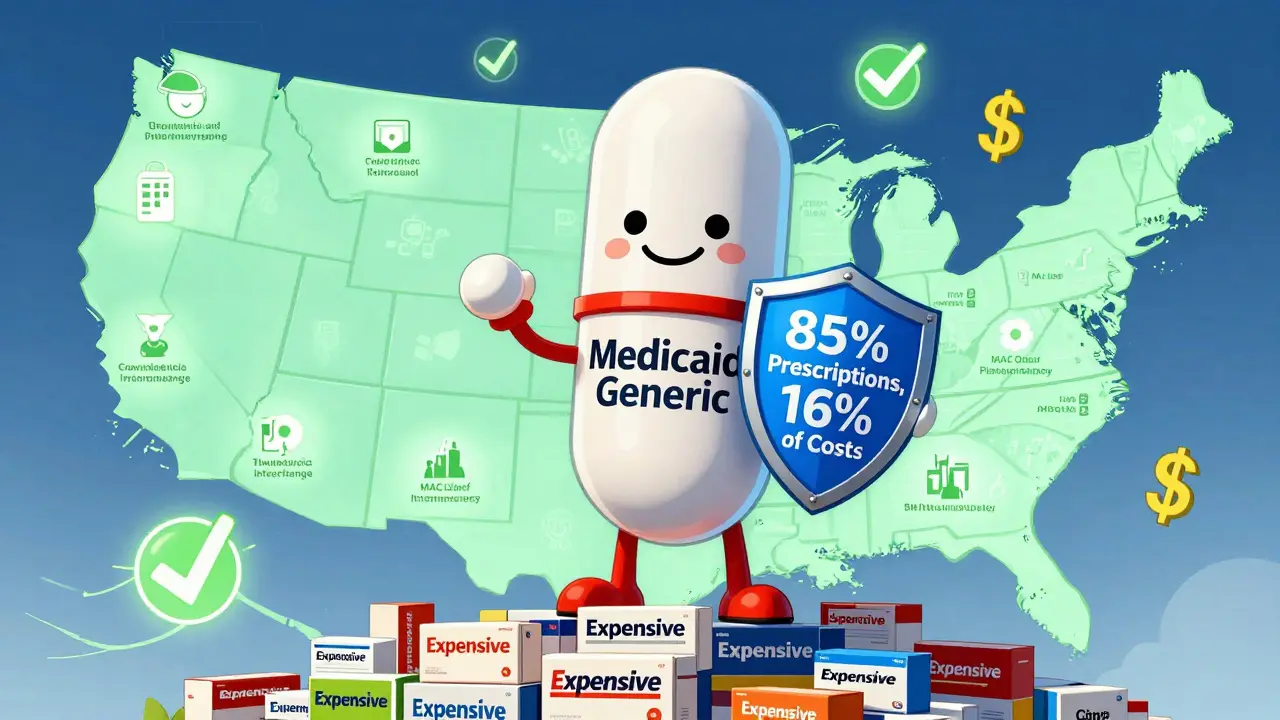
When it comes to controlling prescription drug costs in Medicaid, generic drugs are the quiet heroes. They make up nearly 85% of all Medicaid prescriptions, yet they account for less than 16% of total drug spending. That’s the power of generics - and it’s why states are getting smarter about how they use them to save money without hurting patient access.
How Medicaid Gets Its Generic Drug Discounts
The federal Medicaid Drug Rebate Program (MDRP) is the backbone of how states pay less for drugs. Since 1990, drug manufacturers have been required to give Medicaid a rebate on every prescription drug they sell - brand or generic. For generic drugs, the rebate is at least 13% of the Average Manufacturer Price (AMP), or the difference between AMP and the "best price" the manufacturer gives to other buyers, whichever is higher. This means even if a generic drug’s price goes up, Medicaid still gets a cut.But here’s the catch: unlike brand-name drugs, where states can negotiate extra rebates on top of the federal requirement, they have very little room to bargain for generics. The rebate formula is fixed. So states can’t just haggle for better prices. They have to find other ways.
What States Are Actually Doing
States aren’t sitting around waiting for federal changes. They’ve built their own toolkit to squeeze out savings from generic drugs. Here’s what’s working:- Maximum Allowable Cost (MAC) Lists - 42 states use these to set a cap on how much they’ll pay for each generic drug. If a pharmacy charges more than the MAC, Medicaid won’t cover the full cost. Thirty-one of those states update their lists quarterly or more often to keep up with price swings.
- Mandatory Generic Substitution - 49 states require pharmacists to swap a brand-name drug for its generic version unless the doctor says no. This alone saves billions each year.
- Therapeutic Interchange - 28 states allow pharmacists or pharmacists’ clinical teams to switch a patient from one generic to another within the same drug class if it’s cheaper and equally effective. For example, switching from one statin to another with the same effect but lower cost.
- Price Gouging Laws - Maryland was the first to pass a law in 2020 that blocks manufacturers from raising prices on generic drugs without proof of new clinical value. Since then, states like California, Colorado, and Minnesota have followed with similar rules.
Some states are even going further. Oregon and Texas stopped limiting access to hepatitis C drugs in 2024 because the prices dropped so much. New Hampshire and Texas are now testing new risk-sharing models to handle unpredictable drug costs.
The PBM Problem
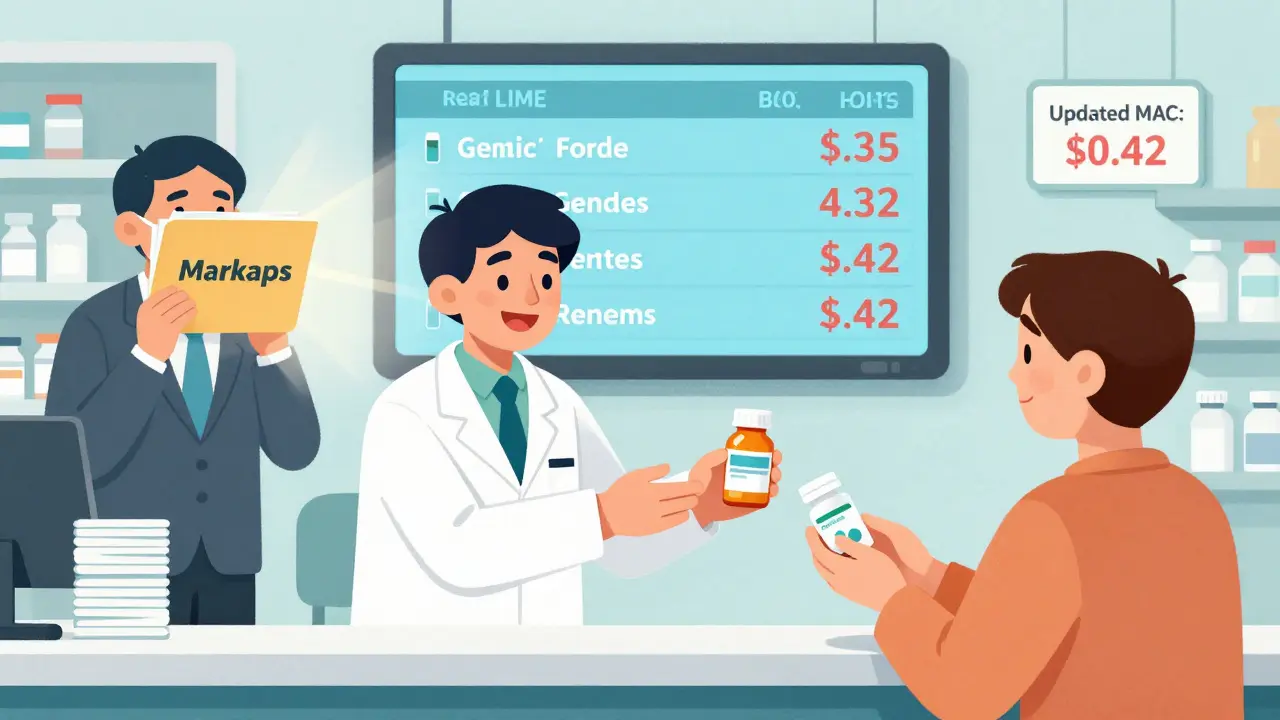
Pharmacy Benefit Managers (PBMs) - companies that manage drug benefits for Medicaid - are a major part of the puzzle. Thirty-three states contract with PBMs like OptumRx or Magellan to handle pharmacy claims. But here’s the issue: PBMs often keep part of the rebate money instead of passing it all to the state. In 2024, 27 states passed new rules to force PBMs to disclose how much they paid for each generic drug. Nineteen of those states now require them to report the actual acquisition cost. That transparency is starting to reveal hidden markups.Independent pharmacies report that 74% have faced delayed payments or claim denials because MAC lists weren’t updated in time. When a drug’s price drops below the MAC, but the state hasn’t updated its list, pharmacies get stuck. That’s not just a paperwork problem - it’s a access problem.
Supply Chain Risks and Shortages
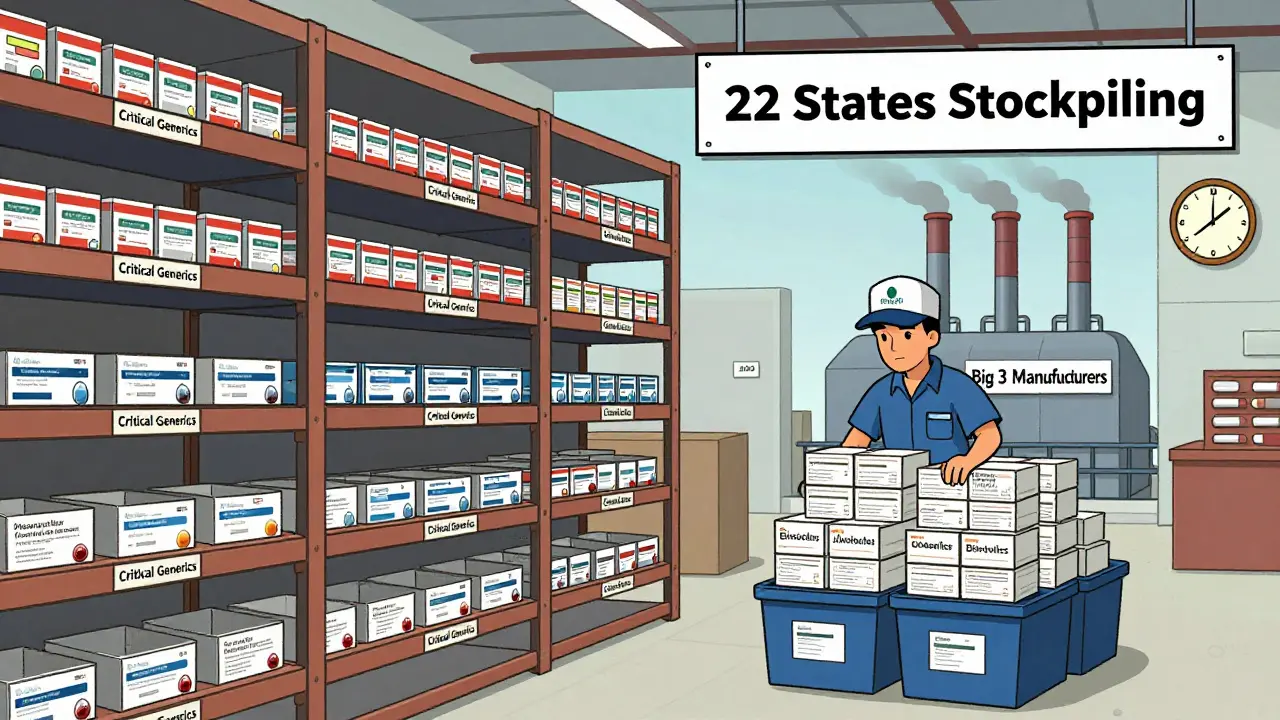
Even with all these cost-control tools, states are facing a growing threat: shortages. In 2023, 23 states reported shortages of critical generic drugs like antibiotics, insulin, and blood pressure medications. The average shortage lasted more than four months. The problem? A handful of manufacturers control most of the market. Three companies now make 65% of all generic injectables in the U.S., according to FDA data.Twelve states introduced legislation in 2024 to build emergency stockpiles of high-demand generics. By 2026, the National Academy for State Health Policy expects 22 states to have formal stockpiling programs. It’s not just about saving money anymore - it’s about making sure patients can get their meds when they need them.
What’s Coming Next
The biggest shift on the horizon? State policies are turning from just controlling prices to protecting supply. The federal government is stepping back. In March 2025, CMS announced it was shelving its own drug pricing model, putting the burden squarely on states. That means more states will likely follow the lead of Oregon and Washington, which now run a multi-state purchasing pool to negotiate supplemental rebates on 47 high-volume generics.Meanwhile, new drugs like GLP-1 medications for obesity - which cost $12,000 a year - are starting to creep into Medicaid formularies. Thirteen states already cover them, usually with strict prior authorization. If federal rules change to require coverage, that could add $1.2 billion a year to state Medicaid budgets. States are watching closely.
The Congressional Budget Office estimates that state-level generic drug policies could cut spending by $3.8 billion annually by 2027. But they also warn: if states go too far - setting prices so low that manufacturers quit the market - shortages could get worse. And when generics disappear, patients end up on more expensive brand-name drugs. That could raise overall Medicaid spending by 2.3%.
It’s a Balancing Act
There’s no one-size-fits-all solution. States that rely too heavily on MAC lists risk cutting off access. States that ignore PBM transparency lose millions in hidden rebates. And states that don’t plan for shortages could see patients go without life-saving drugs.The most successful states are the ones doing all three: setting smart price caps, demanding transparency from PBMs, and building backup plans for drug shortages. They’re not just trying to save money - they’re trying to make sure the system still works when it matters most.
Do all states have the same generic drug policies?
No. While all states cover prescription drugs in Medicaid, each designs its own rules. Some use strict Maximum Allowable Cost lists, others rely on therapeutic interchange, and a few have passed laws to block price hikes on generics. Only 19 states actively changed how they reimburse for generics in 2023, showing wide variation in approach.
Why can’t states negotiate better rebates for generic drugs like they do for brand-name drugs?
The federal Medicaid Drug Rebate Program sets fixed rebate formulas for generics - usually 13% of the Average Manufacturer Price. Unlike brand-name drugs, where states can add supplemental rebates through negotiations, there’s no legal mechanism for extra discounts on generics. That limits states’ flexibility and forces them to rely on other tools like MAC lists and substitution rules.
What’s a Maximum Allowable Cost (MAC) list and how does it work?
A MAC list is a state-set price cap for each generic drug. If a pharmacy charges more than the MAC, Medicaid only pays up to the cap, and the pharmacy absorbs the rest. This pushes pharmacies to source generics at lower prices. Forty-two states use MAC lists, and 31 update them quarterly to match real-time market changes.
Are state efforts to control generic drug prices causing shortages?
There’s evidence of risk. Aggressive price caps or rebate changes can make it unprofitable for manufacturers to produce certain generics. The Congressional Budget Office warns that overly strict controls could reduce availability. But the bigger driver of shortages is manufacturing consolidation - three companies control 65% of generic injectables - not state pricing policies alone.
How are states dealing with Pharmacy Benefit Managers (PBMs)?
Twenty-seven states passed new PBM transparency rules in 2024. Nineteen now require PBMs to report the actual cost they paid for each generic drug. This helps states catch hidden markups and ensures rebates are properly passed through. Some states are also moving away from PBMs altogether, managing pharmacy benefits directly to reduce middleman costs.
What’s the future of Medicaid generic drug policies?
The focus is shifting from just cutting prices to securing supply. By 2026, 22 states are expected to have strategic stockpiles of critical generics. Multi-state purchasing pools are growing, and more states are adopting laws to prevent price gouging. The goal is no longer just savings - it’s stability, reliability, and ensuring patients get the drugs they need, no matter what.



Gwen Vincent
24 February / 2026It’s wild how much we take generics for granted. I’ve been on the same blood pressure med for years-same generic, same price, never thought about where it came from. Turns out, some pharmacist in Ohio is juggling 12 different MAC lists just to get me my pills on time. We need better systems, not just tighter caps.