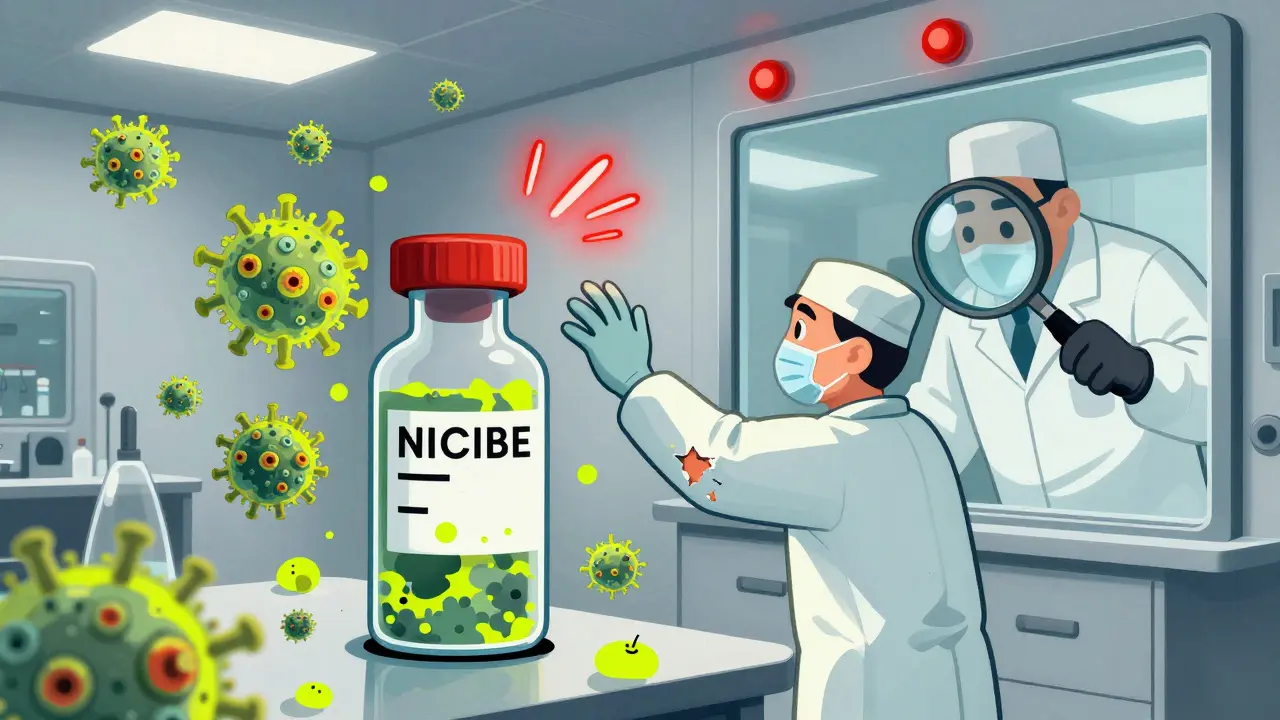
When you take a pill, use an inhaler, or get an IV drip, you assume it’s safe. But behind every medicine or medical device is a factory-often overseas-where tiny mistakes can lead to big dangers. The FDA doesn’t wait for harm to happen. It sends inspectors into factories, digs through records, and shuts down production when things go wrong. In 2025, the agency issued 32% more warning letters for quality issues in medical device manufacturing than in 2024. That’s not random. It’s a targeted crackdown. And the problems they’re finding aren’t obscure. They’re basic, repeatable, and preventable.
Aseptic Processing Failures: The Silent Killer
The most common issue in 2025? Aseptic processing. That’s the process of making sterile products-like injectables, eye drops, or IV solutions-without letting bacteria or fungi in. It sounds simple. It’s not. In 47% of FDA warning letters this year, inspectors found facilities couldn’t prove their clean rooms were actually clean.
One company, Health and Natural Beauty USA Corp., got hit in July 2025 because their media fill studies-the test that simulates production to catch contamination risks-were outdated. They hadn’t done one in over two years. Another, Creative Essences, Inc., was cited in September for letting workers enter sterile zones without proper gowning. One wrong move, one torn glove, one unfiltered breath-and a batch of insulin could become deadly.
The FDA doesn’t just say “fix it.” They demand proof. That means redoing media fills, upgrading air filters, retraining staff, and showing they can consistently produce sterile products for at least three runs in a row. It’s expensive. It’s time-consuming. But skipping it risks lives.
Data Integrity: When Records Lie
Here’s the scary part: many companies know the rules. They just don’t follow them. Data integrity failures showed up in 39% of 2025 warning letters. That’s not just missing paperwork. It’s falsified data.
Guangxi Yulin Pharmaceutical Group Co. Ltd. was cited in September because their UV-Vis spectrometers-machines that test drug purity-had no audit trails. Someone could change a result, delete a test, or skip a step, and there’d be no record. Another company used laminated production logs with erasable markers. You can wipe out a mistake. But you can’t wipe out the truth.
The FDA’s ALCOA+ standard isn’t optional. Records must be:
- Attributable
- Legible
- Contemporaneous
- Origina
- Accurate
- + Complete, Consistent, Enduring, Available
Fixing this isn’t about buying new software. It’s about culture. If your production team feels pressured to meet deadlines over accuracy, data will get cooked. The FDA now looks at who signs off, who edits, and why. They check timestamps. They compare electronic logs with paper records. And if they find a pattern of manipulation, they shut you down.
Material Control: Dirty Ingredients, Deadly Results
Bad raw materials don’t just ruin a batch-they kill people. In 2007, diethylene glycol (DEG) in fake glycerin caused over 100 deaths worldwide. That’s why the FDA now demands proof every ingredient is clean.
Health and Natural Beauty USA Corp. got a warning letter in July 2025 because they didn’t test glycerin and sorbitol for DEG contamination. They trusted their supplier. That’s not good enough. The FDA requires testing at 0.1% sensitivity-meaning even trace amounts must be caught. USP General Chapter <1085> spells out how to do it right.
But it’s not just about testing. It’s about verifying your supplier’s tests. Foshan Yiying Hygiene Products Co., Ltd. was cited in May because they accepted supplier certificates without checking if the lab was accredited or if the methods were valid. The FDA expects you to audit your suppliers. Not once. Not every five years. Regularly. With documentation.
Process Validation: If You Haven’t Proven It, It Doesn’t Work
Manufacturing toothpaste isn’t the same as making a cancer drug. But the FDA treats both with the same rigor. If you can’t prove your process works every time, you’re gambling with patient safety.
Health and Natural Beauty USA Corp. again-this time for failing to validate their toothpaste manufacturing process. No one checked if the mixing temperature, blending time, or homogeneity met specifications. The FDA expects three consecutive batches to pass all tests under real production conditions. That’s not a suggestion. It’s the law.
Same goes for analytical methods. Guangxi Yulin didn’t validate their HPLC test for drug potency. So how did they know if their pills had the right dose? They didn’t. And the FDA doesn’t care if you’ve been doing it “the same way for 10 years.” If it’s not scientifically proven, it’s not compliant.
Quality Culture: The Root of All Problems
Here’s what the FDA won’t say out loud-but everyone in the industry knows: most of these failures come from the same place. Leadership.
Dr. David Lim of Compliance Architects found that 78% of companies cited in 2025 warning letters had a culture where speed beat safety. Managers pushed for faster production. Quality teams were ignored. Budgets for training got cut. When an inspector showed up, staff didn’t know the procedures. Or worse-they knew them but were told to “make it look right.”
The FDA’s new Quality Management Maturity (QMM) program, launched in 2024, is designed to catch this. It’s not about checking boxes. It’s about asking: Do you reward honesty? Do you empower your quality team to stop production? Do leaders sit in on quality reviews?
Facilities with strong quality cultures have 63% fewer repeat findings and fix problems 41% faster. That’s not luck. It’s leadership.
Where Are These Problems Happening?
The FDA isn’t playing favorites. But the data shows patterns. In 2025:
- Chinese facilities were cited 28 times for failed analytical method validation.
- Indian facilities got 24 warning letters for data integrity issues.
- Malaysian companies were flagged 9 times for weak quality unit authority.
Why? In China, some labs still use outdated instruments without digital controls. In India, the national regulator (CDSCO) inspects fewer than 2% of domestic facilities each year-so companies assume the FDA won’t notice. That’s a dangerous bet.
The FDA has increased unannounced inspections by 40% in 2025, and 68% of those targeted Asian plants. They’re not just checking paperwork. They’re walking the floor. Watching the workers. Testing the air. And they’re not leaving until they’re sure.
What Happens When You Get Caught?
Getting a warning letter isn’t the end. But it’s the start of a long, expensive recovery.
92% of 2025 warning letters required hiring an independent CGMP consultant. That’s not cheap. It’s often $150-$300 an hour. And you’ll need them for 6 to 18 months.
Then there’s the cost of fixing the systems:
- Data integrity? You need validated audit trails with 180-day retention, user access controls, and sequential timestamps.
- Material control? You need new testing protocols, supplier audits, and certificates of analysis from accredited labs.
- Process validation? You need three successful batches, documented from start to finish.
And if you’re on Import Alert 66-40? Your products are blocked at the border. No inspection. No entry. Not until you prove you’ve fixed everything. That can take over a year.
The Future Is Cultural, Not Technical
The FDA’s next big move? They’re starting to use quality culture as a factor in inspection frequency. Starting in Q2 2026, companies that participate in the QMM program might get fewer inspections-if they show real change. Those with poor culture? More frequent visits. Longer holds. Higher risk of shutdown.
They’re also watching new tech: cloud-based quality systems, continuous manufacturing, and AI-driven analytics. Twelve warning letters in 2025 already cited poor controls for digital platforms. If your quality data lives in a shared Google Drive, you’re already behind.
Global spending on CGMP compliance hit $4.7 billion in Q3 2025. That’s not waste. It’s insurance. The cost of one recall, one death, one shutdown? It’s millions-and your reputation.
There’s no shortcut. No magic software. No quick fix. The only thing that works is building a culture where quality isn’t a department-it’s everyone’s job. From the CEO to the janitor. If you don’t believe that, the FDA will make you believe it.
What are the most common FDA manufacturing deficiencies in 2025?
The top three are aseptic processing failures (47% of warning letters), data integrity issues (39%), and material control lapses (35%). These include outdated media fills, missing audit trails, and untested raw materials like glycerin for DEG contamination.
What happens if a company gets an FDA warning letter?
The company must fix the issues, often by hiring an independent CGMP consultant. Remediation takes 6-18 months. If violations are severe, the facility is placed on Import Alert 66-40, blocking all U.S. imports until compliance is proven. Repeat offenses can lead to criminal charges.
Why is data integrity such a big deal for the FDA?
Data integrity ensures that test results, production logs, and quality controls are accurate and untampered. If records can be erased or altered, there’s no way to guarantee product safety. The FDA requires ALCOA+ compliance: records must be attributable, legible, contemporaneous, original, accurate, and complete, consistent, enduring, and available.
Are U.S. facilities also being inspected more often?
Yes. In 2025, the FDA conducted 850 unannounced inspections, mostly overseas. In 2026, they plan to increase that to 1,200-including domestic sites. No facility is safe from surprise visits.
How can a manufacturer avoid FDA deficiencies?
Build a strong quality culture where employees feel safe reporting errors. Invest in validated systems, train staff regularly, audit suppliers, and never skip process validation. Use the FDA’s QMM program to assess your maturity before you get inspected. Prevention is cheaper-and safer-than a shutdown.




William Liu
18 December / 2025The FDA is finally doing its job. For years, we’ve let overseas factories cut corners while American patients paid the price. This crackdown isn’t about fear-it’s about accountability. If you’re making medicine, you owe it to people to get it right. No excuses.