Every year, medication errors cause tens of thousands of preventable deaths in hospitals and pharmacies. In the U.S. alone, about 250,000 people die annually because of mistakes in how drugs are ordered, dispensed, or given. Many of these errors happen not because someone was careless, but because the system was broken. That’s why patient safety goals in medication dispensing aren’t optional-they’re life-or-death requirements.
What Are the National Patient Safety Goals (NPSGs)?
The National Patient Safety Goals (NPSGs) are a set of standards created by The Joint Commission, the main organization that accredits hospitals in the U.S. First introduced in 2003, these goals were designed to fix the biggest, most dangerous problems in healthcare. Medication safety has always been at the top of the list.Today’s NPSGs focus on six key areas, but the ones that matter most to pharmacists and pharmacy staff are:
- Identify patients correctly
- Improve staff communication
- Use medicines safely
- Prevent infection
- Identify patient safety risks
- Prevent mistakes in surgery
For pharmacy practice, the most critical goal is Use medicines safely. This includes everything from labeling syringes correctly to making sure high-alert drugs like insulin or heparin are handled with extra care. The Joint Commission doesn’t just say “be careful.” They require measurable actions. For example, NPSG.03.04.01 says every medication container-even a syringe on an operating table-must have a label with the drug name, strength, and concentration, in at least 10-point font. No exceptions.
Why the Five Rights Aren’t Enough
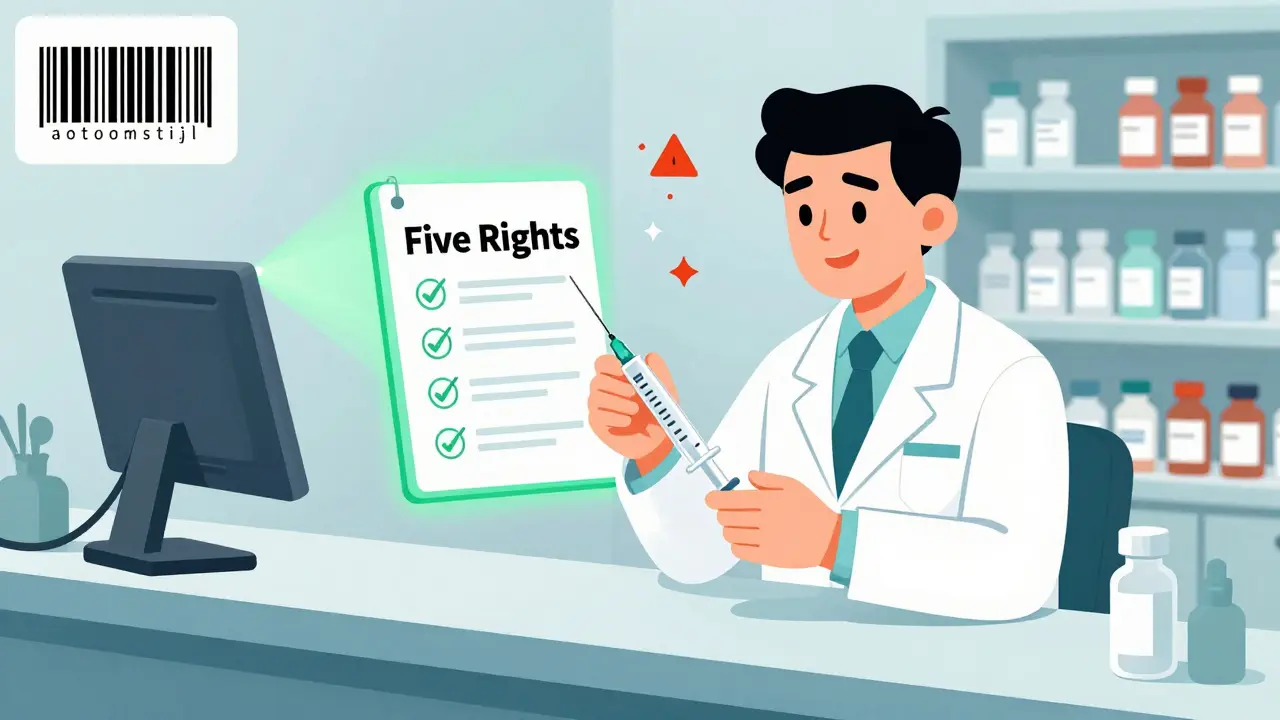
You’ve probably heard the Five Rights: right patient, right drug, right dose, right route, right time. It’s taught in every pharmacy school. But here’s the problem: 83% of medication errors still happen even when nurses and pharmacists check all five.Why? Because the Five Rights put all the pressure on the person at the counter. If you’re a nurse doing 12-hour shifts with eight patients, and you’re running behind, you don’t have time to triple-check every label. You rely on systems to catch mistakes before they reach the patient.
The Institute for Healthcare Improvement (IHI) says it plainly: the Five Rights are a checklist, not a safety system. Real safety comes from designing systems that make errors hard to make. That’s why barcode scanning, automated dispensing cabinets, and electronic prescribing aren’t just nice-to-haves-they’re the new baseline.
High-Alert Medications: The Quiet Killers
Not all drugs are created equal. Some are so dangerous that even a small mistake can kill. These are called high-alert medications. Examples include insulin, morphine, potassium chloride, and heparin. The ISMP (Institute for Safe Medication Practices) tracks these closely and has identified 19 high-risk scenarios that need urgent fixes.One shocking case: injectable promethazine. Between 2006 and 2018, 37 patients lost limbs because this drug was accidentally injected into an artery instead of a vein. That’s not a rare mistake-it’s a preventable one. The fix? Clear labeling, separate storage, and mandatory double-checks before administration.
Another high-risk area: anticoagulants like warfarin. The NPSG requires hospitals to have standardized protocols for monitoring INR levels, educating patients, and documenting therapeutic ranges. Compliance must hit 95% quarterly. That’s not a suggestion. That’s an audit requirement.
Technology That Actually Works
The best safety tools aren’t flashy. They’re simple, reliable, and built into daily workflow.Barcode Medication Administration (BCMA) is one of the most effective. Hospitals that use it report up to an 86% drop in wrong-drug errors. But there’s a catch: it adds 7.2 minutes per dose to nurse workload. That’s why some hospitals cut corners-until they see the numbers. One study found that facilities with low BCMA compliance had 3.7 times more medication errors.
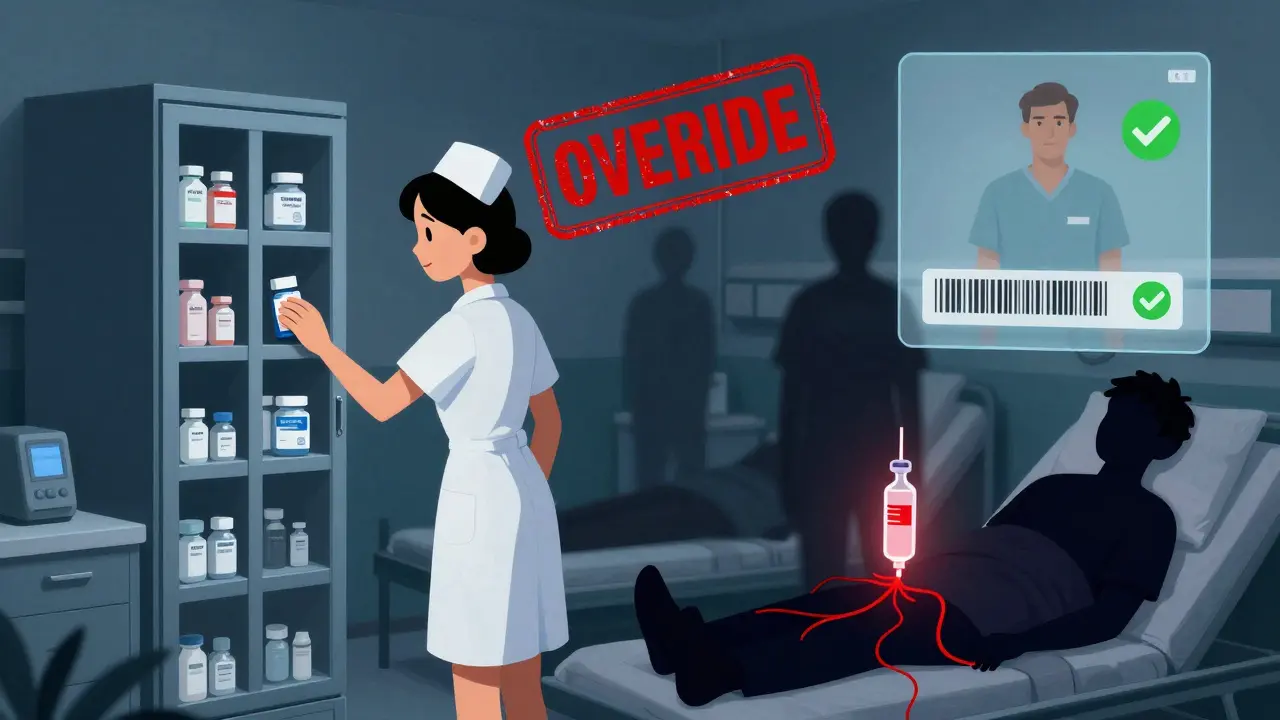
Automated Dispensing Cabinets (ADCs) are another key tool. These locked drawers let nurses pull meds on the floor, but they also create a new risk: overrides. When a nurse bypasses the system to grab a drug without scanning or verifying, it’s called an override. The Joint Commission says override rates should stay under 5%. But in reality, 34% of pharmacists report rates higher than that-mostly because of “stat” orders in emergencies.
That’s why smart hospitals don’t just ban overrides. They analyze why they happen. Is it because the cabinet is too far from the unit? Are the right drugs not stocked? Do staff feel rushed? Fix the system, not the person.
What Australia Does Differently
Australia’s approach to medication safety, guided by ASHP (Australian Society of Health-System Pharmacists), focuses less on blaming individuals and more on fixing systems. Their guidelines stress:- Standardized procedures for high-risk drugs
- Barcode scanning in all areas-not just inpatient units
- Regular reviews of medication errors, not just incident reports
- Training that’s ongoing, not a one-time compliance checkbox
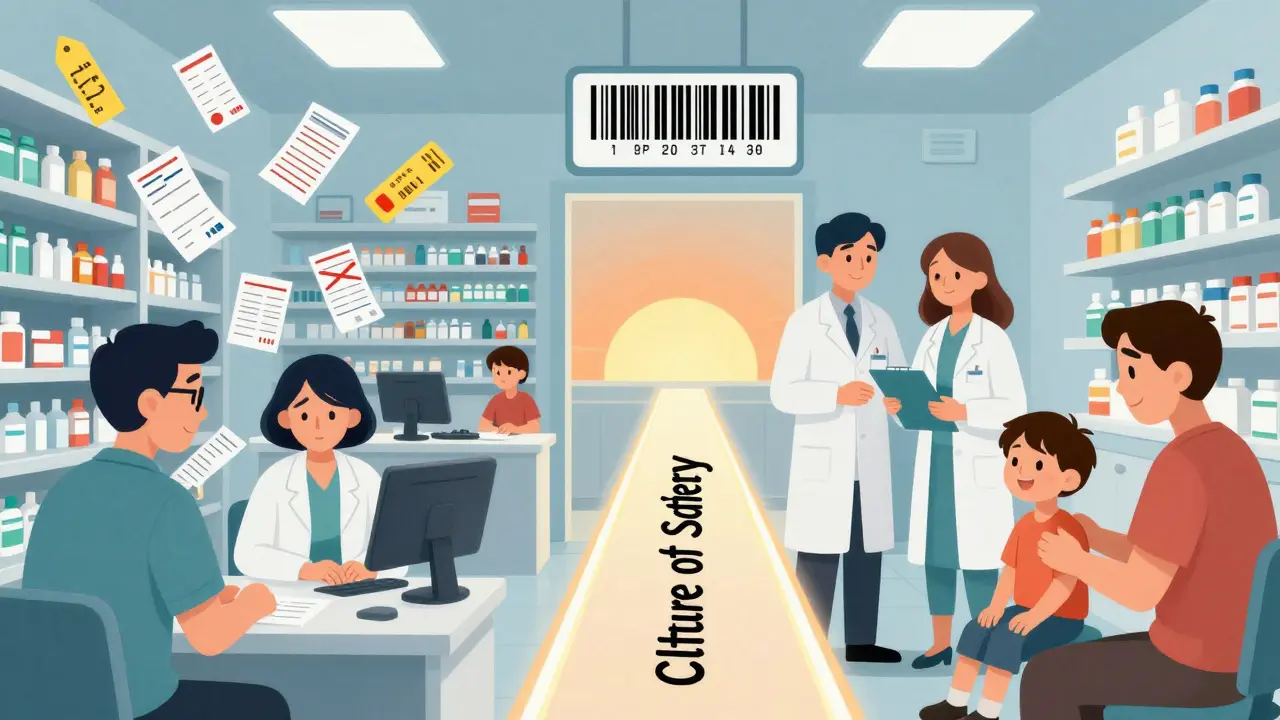
This mindset shift-from “did the nurse make a mistake?” to “why did the system let this happen?”-is what separates good pharmacies from great ones. It’s not about finding someone to punish. It’s about building a culture where errors are seen as signals, not failures.
The Pediatric Problem
Children aren’t small adults. Their bodies process drugs differently. That’s why medication errors in pediatric units are three times more common than in adult units. The biggest culprit? Weight-based dosing errors.At Children’s Hospital of Philadelphia, they cut these errors by 91% using three simple changes:
- Standardized weight-based dosing charts for every drug
- Double-checks by two staff members for high-alert meds
- Electronic alerts that flag doses outside safe ranges
They didn’t hire more pharmacists. They didn’t buy expensive AI. They just made the right process the easiest path.
What’s New in 2025?
The 2025 NPSGs aren’t just repeats. They’re responses to new risks.- Bedside specimen labeling: Labels must now be applied in front of the patient, using two identifiers (name and DOB). This cuts down on 160,000 annual errors from mislabeled blood samples.
- ADC override management: Hospitals must now analyze override patterns and reduce them through workflow redesign-not just warnings.
- Vaccine safety: New guidelines target errors in pediatric vaccine administration, which now make up 21% of pediatric medication incidents.
These aren’t theoretical. They’re based on real data. One hospital in Texas reduced vaccine errors by 79% after implementing pre-filled syringes with color-coded labels and mandatory scanning before injection.
How to Actually Implement These Goals
Knowing the goals isn’t enough. You need a plan.Here’s what works:
- Start with a gap analysis. Use ECRI’s self-assessment tool. Score your pharmacy on ISMP best practices. If you’re under 60%, you’re at risk.
- Train for 8-12 hours per staff member. Not a 30-minute video. Real training with case studies, simulations, and role-playing.
- Use technology wisely. Barcode scanning? Yes. AI-powered alerts? Yes. Fancy apps no one uses? No.
- Measure what matters. Track override rates, labeling compliance, and error trends-not just “number of incidents.”
- Get leadership involved. Pharmacies with executive sponsorship have an 89% success rate in sustaining safety programs. Those without? 42%.
And don’t forget documentation. The Joint Commission doesn’t ask if you’re safe. They ask: “Can you prove it?” Keep training logs, error reports, and compliance metrics. Missing records = failed audit.
The Bigger Picture
Medication safety isn’t just a pharmacy issue. It’s a system-wide challenge. The global patient safety software market is growing fast-projected to hit $4 billion by 2028. Why? Because regulators are tying reimbursement to safety outcomes. In the U.S., 2% of hospital payments are now at risk based on how many preventable errors occur.But money isn’t the real driver. People are. Every label you miss, every override you ignore, every double-check you skip-someone’s life is on the line. Not a statistic. Not a number. A person. A parent. A child. A grandparent.
The tools are here. The standards are clear. The data is undeniable. What’s missing is the will to make safety the default-not the exception.
What are the most common medication dispensing errors in pharmacies?
The most common errors include wrong drug selection (often due to similar-looking labels), incorrect dosing (especially in children), mislabeled syringes, and failure to verify patient identity. Automated dispensing cabinet overrides and poor communication between prescribers and pharmacists also contribute significantly. Studies show that 60% of dispensing errors occur during the final check phase, often because staff are rushed or distracted.
How do NPSGs differ from ISMP best practices?
NPSGs are mandatory standards set by The Joint Commission for accredited hospitals-failure to comply can mean losing accreditation. ISMP best practices are voluntary guidelines developed by medication safety experts. While NPSGs focus on minimum compliance (like labeling and patient ID), ISMP targets deeper system fixes like reducing override rates, preventing specific high-risk errors, and improving workflow design. About 68% of large hospitals use both.
Why are automated dispensing cabinet overrides dangerous?
Overrides let staff bypass safety checks like barcode scanning or dose limits. When override rates exceed 5%, hospitals see 3.7 times more medication errors. Most overrides happen during emergencies, but studies show that 70% of these are avoidable with better staffing, faster access to needed drugs, or pre-stocked emergency kits. Treating overrides as normal is like ignoring a smoke alarm-eventually, the fire comes.
Can technology alone prevent medication errors?
No. Technology like barcode scanning and AI alerts reduces errors by up to 80%, but only if staff use them correctly and the system is designed well. If a nurse finds the scanner too slow or the alerts too noisy, they’ll disable them. The best systems combine technology with training, culture, and leadership support. Safety isn’t a gadget-it’s a habit.
What role do pharmacists play in patient safety?
Pharmacists are the last line of defense before a drug reaches the patient. They verify prescriptions, catch dosing errors, check for drug interactions, and educate staff on high-alert medications. But their role goes beyond checking. They lead safety audits, train nurses, design labeling systems, and analyze error trends. In high-performing pharmacies, pharmacists don’t just dispense-they redesign the system.
How can patients help prevent medication errors?
Patients can ask simple questions: “What is this medicine for?” “Is this the same as what I took before?” “Can you check my name and birth date?” Facilities with active patient engagement programs report 42% fewer errors. When patients are involved in verifying their meds, mistakes drop. It’s not about blaming patients-it’s about making them part of the safety team.
What Comes Next?
The future of medication safety isn’t about more rules. It’s about smarter systems. AI is already being tested at places like Mayo Clinic to predict which patients are at highest risk for adverse drug events. In pilot programs, AI reduced potential errors by 47% by flagging unusual prescriptions before they’re even filled.But the real breakthrough will come when safety becomes part of the culture-not a checklist. When pharmacists feel empowered to stop a dangerous order. When nurses aren’t afraid to speak up. When leadership invests in systems, not just slogans.
The goal isn’t perfection. It’s progress. One label at a time. One scan at a time. One life at a time.


James Nicoll
25 January / 2026So we’ve got robots scanning barcodes, AI predicting errors, and 19-point font on syringes… but still, someone’s kid gets a lethal dose of potassium because the nurse was ‘rushing’? Classic. We’re automating the symptoms while the disease-burnout, understaffing, and leadership that thinks ‘compliance’ is a buzzword-keeps spreading. Safety isn’t a checklist. It’s a fucking culture. And right now, we’re running a funeral home with a PowerPoint on ‘best practices.’