
Melatonin-Sedative Interaction Checker
Check Your Medication Safety
This tool helps you understand potential risks when combining melatonin with sedatives. It is not a substitute for medical advice. Always consult your doctor before making changes to your medication regimen.
Safety Recommendations
This tool is for informational purposes only. It does not replace professional medical advice. If you experience excessive drowsiness, confusion, or breathing difficulties, seek emergency medical help immediately.
Combining melatonin with sedatives might seem like a quick fix for tough nights, but it’s far more dangerous than most people realize. You take a 3mg melatonin gummy because you’re still awake at midnight, then grab your prescribed zolpidem or alprazolam because you’re worried you won’t sleep at all. Sounds logical, right? Wrong. What happens when these two hit your system together isn’t just double sleepiness-it’s a slippery slope into deep, unpredictable sedation that can leave you unconscious for hours, disoriented, or even in danger.
Why Melatonin Isn’t Just a ‘Natural’ Sleep Aid
Melatonin is often called a natural sleep hormone, and technically, it is. Your body makes it naturally in response to darkness, signaling it’s time to wind down. But when you take it as a supplement, you’re flooding your system with something that acts like a chemical key-turning on sleep pathways in your brain. It binds to receptors in your brain’s internal clock, but it also interacts with GABA and opioid receptors, which are the same ones targeted by prescription sedatives. That’s where the trouble starts.Unlike prescription sleep drugs, melatonin isn’t tightly regulated in the U.S. You can buy it at any pharmacy, grocery store, or online without a prescription. But that doesn’t mean it’s harmless. A 2023 study from the National Institutes of Health found that 3.1 million American adults used melatonin that year-and usage has jumped 165% since 2007. Yet most people have no idea how it interacts with other medications they’re already taking.
What Happens When Melatonin Meets Sedatives
Sedatives like benzodiazepines (diazepam, lorazepam), non-benzodiazepine hypnotics (zolpidem, eszopiclone), and even some antidepressants or antipsychotics all work by slowing down your central nervous system. They make you drowsy, relaxed, and less alert. Melatonin doesn’t just add to that-it multiplies it.Research published in the Journal of Clinical Sleep Medicine showed that combining melatonin with benzodiazepines increases the risk of respiratory depression by 47%. That’s not a small bump. That’s a sharp rise into territory where breathing becomes shallow, oxygen levels drop, and your body can’t wake itself up-even if it’s in danger.
And it’s not just about breathing. The additive effect isn’t linear. Two mild sedatives don’t just make you twice as sleepy-they can make you feel like you’ve taken a much stronger dose. As Dr. Neil Stanley, a UK sleep expert, put it: “The additive effects aren’t linear-they’re multiplicative.”
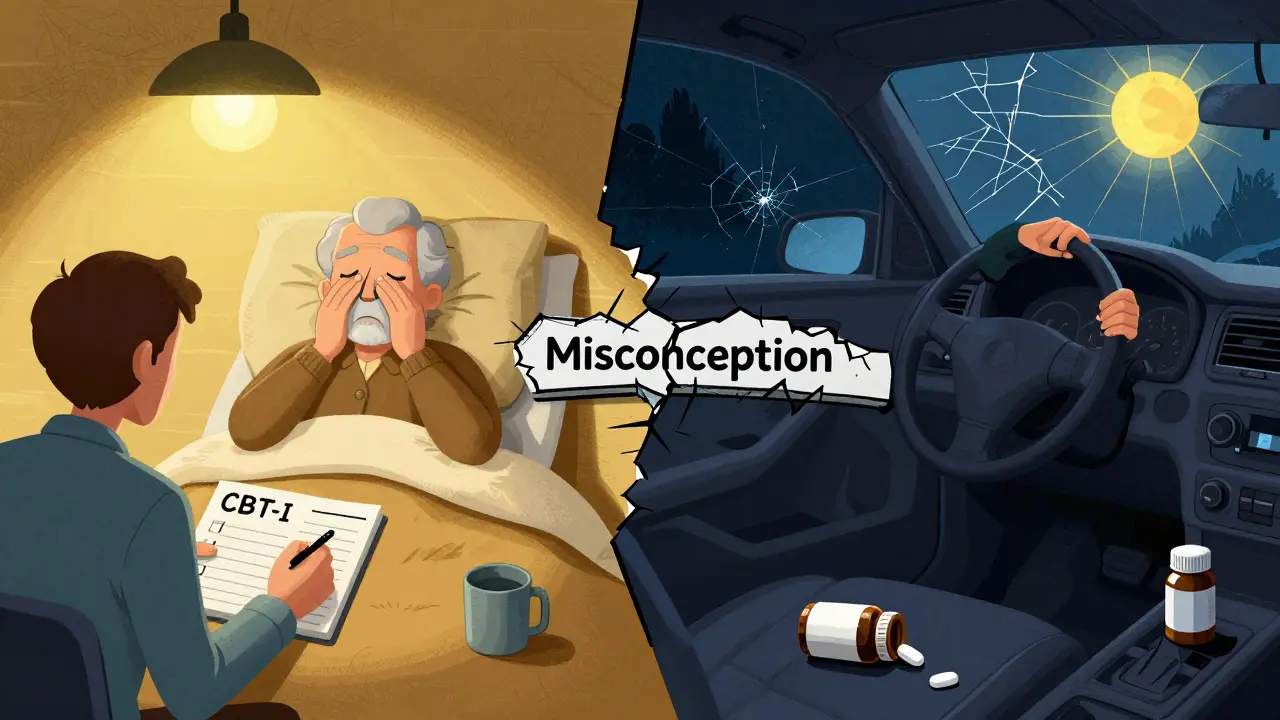
Real-world stories back this up. On Reddit’s r/Sleep forum, users have shared accounts of waking up 14 hours later with no memory of the night after mixing melatonin with Xanax. One man in Arizona drove home after taking 2mg melatonin with his prescribed zolpidem-and woke up in a ditch three miles from his house. He didn’t remember swerving. He didn’t remember braking. He just remembered falling asleep at the wheel.
Who’s Most at Risk
Older adults are especially vulnerable. The American Geriatrics Society’s 2023 Beers Criteria lists melatonin as potentially inappropriate for seniors when combined with sedatives because it raises the risk of falls by 68% compared to using either drug alone. Balance weakens with age. Reaction times slow. Add a double sedative effect, and even standing up too fast can lead to a broken hip.People taking multiple medications are also at higher risk. If you’re on an antidepressant, an antipsychotic, or even an opioid for pain, melatonin can push your total sedative load into unsafe territory. Even over-the-counter antihistamines like diphenhydramine (Benadryl) can act as sedatives and worsen the problem.
And here’s something most people don’t realize: melatonin’s effects vary wildly between individuals. One person might take 5mg and feel nothing. Another might feel groggy after 0.5mg. Why? Because melatonin is metabolized through the liver, and factors like age, liver health, genetics, and other medications can change how fast or slow your body breaks it down. If you’re taking fluvoxamine (an antidepressant), your melatonin levels can spike by up to 170%-a recipe for overdose without even trying.

How to Stay Safe
If you’re taking any sedative-prescription or not-here’s what you need to do:- Don’t combine them without talking to your doctor. Even if you’ve taken melatonin for years, adding a sedative changes everything.
- Use the lowest possible dose. If your doctor approves combining them, start with 0.3mg to 0.5mg of melatonin. That’s less than a quarter of what most store-bought supplements contain.
- Wait at least five hours. The Mayo Clinic recommends spacing melatonin and sedatives by at least five hours. If you take your sedative at 9 p.m., don’t take melatonin until after 2 a.m.-and even then, be cautious.
- Plan for eight hours of sleep. If you’re combining these, give your body extra time to recover. Don’t set your alarm for 6 a.m. if you went to bed at 11 p.m. You might still be groggy at noon.
- Avoid driving or operating machinery. Even if you feel fine, your reaction time is slower. A 2022 survey found that 37% of people who mixed melatonin with sedatives experienced unintended oversedation-some needed emergency care.
Also, choose prolonged-release melatonin if you can. Studies show it reduces interaction risks by 31% compared to immediate-release forms because it mimics your body’s natural release pattern instead of flooding your system all at once.
What’s Changing in 2025
The tide is turning. The FDA issued 12 warning letters to melatonin makers in 2022 for mislabeling and contamination. In 2023, they released draft guidelines requiring all melatonin products to include clear warnings about sedative interactions by mid-2024. The European Medicines Agency already requires it: every melatonin bottle sold in Europe now says “Do not combine with sedatives.”Healthcare providers are catching up, too. In 2018, nearly half of primary care doctors in the U.S. said it was okay to combine melatonin with sedatives. By 2023, that number dropped to 22%. The American Academy of Sleep Medicine now classifies this combination as “conditionally recommended against” unless you’re under close supervision in a sleep clinic.
Meanwhile, alternatives like cognitive behavioral therapy for insomnia (CBT-I) are gaining traction. It’s not a pill. It’s a structured program that reteaches your brain how to sleep. And unlike melatonin or sedatives, it has no interaction risks. The American College of Physicians now recommends CBT-I as the first-line treatment for chronic insomnia.
What to Do If You’ve Already Combined Them
If you’ve taken melatonin with a sedative and feel excessively drowsy, confused, or have trouble breathing, seek help immediately. Don’t wait to see if it “wears off.” Respiratory depression doesn’t always show obvious signs until it’s too late.If you’re just worried you might have overdone it, here’s what to do:
- Stay awake in a safe place-don’t lie down.
- Have someone stay with you.
- Drink water, but don’t force it if you’re too groggy.
- Call your doctor or poison control if symptoms persist beyond 4-6 hours.
And next time? Ask before you combine. It’s not worth the risk.
Can I take melatonin with my sleeping pill?
Generally, no. Combining melatonin with prescription sleep aids like zolpidem, benzodiazepines, or even over-the-counter antihistamines can lead to dangerous additive drowsiness, impaired breathing, and next-day impairment. If your doctor approves it under strict supervision, use the lowest possible dose of melatonin (0.3-0.5mg) and wait at least five hours between doses. Never combine them without medical guidance.
How long does melatonin stay in your system?
Melatonin has a short half-life of 20-50 minutes, meaning half of it leaves your bloodstream in that time. But its effects can last 4-8 hours, especially if you take a higher dose or use an immediate-release form. When combined with sedatives, those effects can linger much longer-sometimes into the next day. Always plan for 8 hours of uninterrupted sleep if you’ve taken both.
Is melatonin safer than sleeping pills?
In terms of dependence and withdrawal, yes-melatonin doesn’t cause physical addiction like benzodiazepines or zolpidem. But in terms of interaction risks, it’s not safer. When combined with sedatives, melatonin can be just as dangerous, if not more so, because people assume it’s harmless. Its effects are unpredictable and can amplify sedation in ways that aren’t obvious until it’s too late.
What’s the best dose of melatonin?
For most people, 0.3mg to 1mg is enough to help with sleep timing. Higher doses (3mg-10mg) are common in stores but aren’t more effective-they just increase side effects like drowsiness, headaches, and nausea. Many supplements contain up to 10 times more than needed. Start low, and only increase if necessary. If you’re on sedatives, stick to 0.3mg-0.5mg.
Can melatonin cause next-day grogginess?
Yes. About 8.7% of people taking melatonin report daytime drowsiness, according to the Mayo Clinic. That number jumps significantly when combined with sedatives. If you’re still feeling foggy at noon, you took too much-or combined it with something that made it stronger. Reduce your dose, avoid mixing, and make sure you’re getting 7-8 hours of sleep.
Are there safer alternatives to melatonin and sedatives?
Yes. Cognitive behavioral therapy for insomnia (CBT-I) is the most effective long-term treatment for chronic sleep problems, with no side effects or drug interactions. It’s recommended as first-line treatment by the American College of Physicians. Other options include improving sleep hygiene-consistent bedtime, no screens before bed, keeping the room cool and dark-and avoiding caffeine after 2 p.m. For many, these changes work better than any pill.



Janette Martens
28 December / 2025so like... melatonin is just sugar gummies with a fancy label right? why are we acting like it's nuclear waste? i took 10mg with my xanax and woke up fine. my cat even slept on my chest. no big deal.