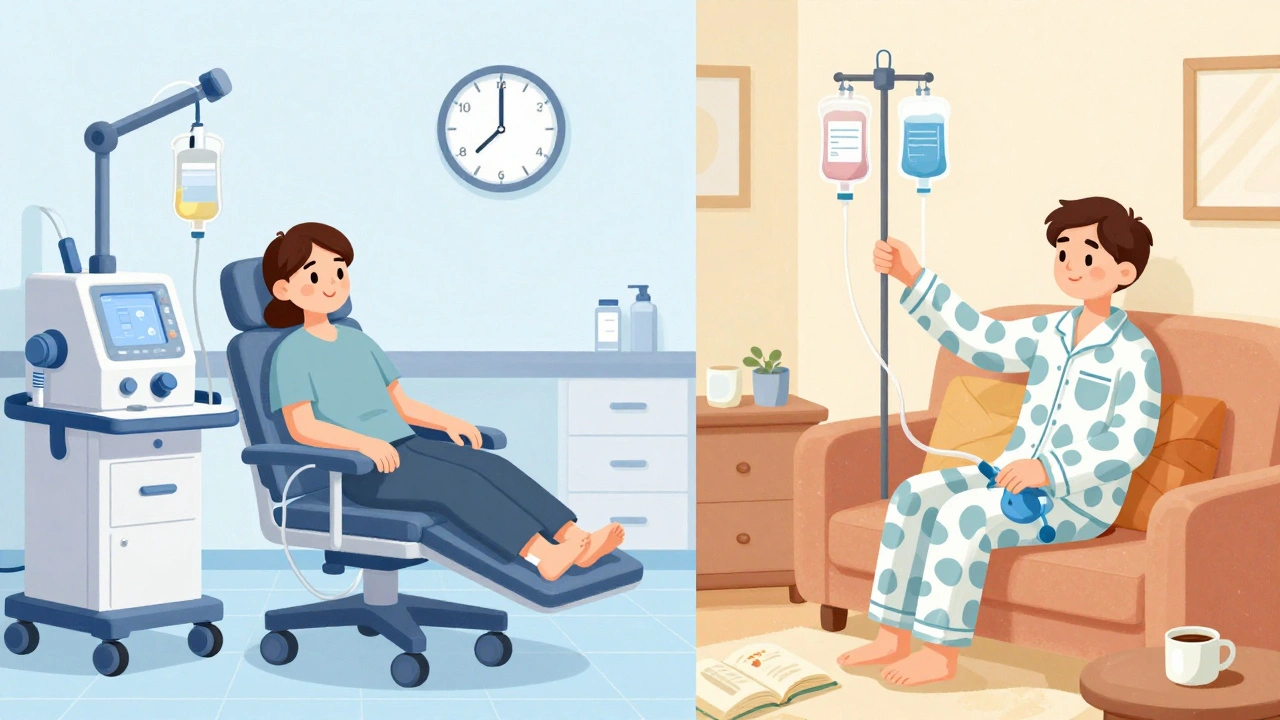
When your kidneys fail, you need a way to clean your blood. Two main options exist: hemodialysis and peritoneal dialysis. Both do the same job-remove waste and extra fluid-but they do it in completely different ways. One uses a machine outside your body. The other uses the lining inside your belly. Which one is right for you? It’s not just about medical facts. It’s about your lifestyle, your body, and what you can manage day after day.
Most people in the U.S. choose hemodialysis. About 70% of dialysis patients use it. But that doesn’t mean it’s better. In fact, studies show peritoneal dialysis often gives better control over blood pressure, less stress on the heart, and keeps your remaining kidney function longer. Yet, fewer people choose it. Why? Because it requires more from you. And that’s the real difference.
How Hemodialysis Works
Hemodialysis pulls your blood out of your body, cleans it through a machine, and puts it back in. You sit in a clinic three times a week, for three to five hours each time. A needle goes into your arm, connected to tubes that lead to the dialysis machine. The machine filters your blood at a rate of 300 to 500 milliliters per minute.
To make this work, you need a vascular access. The best option is an arteriovenous (AV) fistula-a connection made between an artery and a vein in your arm. It takes 6 to 8 weeks to heal and mature before you can use it. If that’s not possible, a graft or a catheter might be used. Catheters are quicker to set up but carry higher infection risks.
Each session removes a lot of waste quickly. The clearance goal is a Kt/V of 1.2 to 1.4 per treatment. That sounds technical, but it means your blood gets cleaned thoroughly in those few hours. The downside? You feel drained afterward. Many patients say they’re exhausted for hours. Your blood pressure can drop suddenly during treatment. Fluid and potassium build up between sessions, which can cause cramps, shortness of breath, or heart strain.
How Peritoneal Dialysis Works
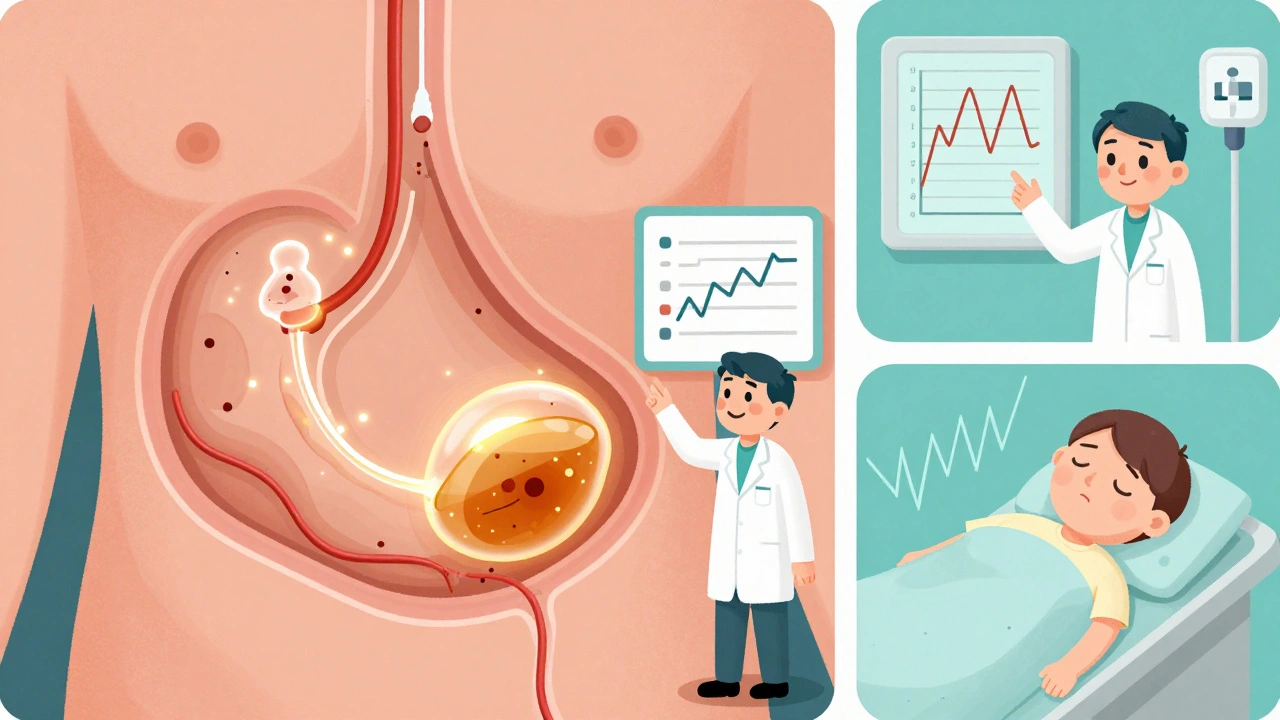
Peritoneal dialysis doesn’t need a machine to clean your blood externally. Instead, it uses your own peritoneum-the membrane lining your abdomen-as a filter. A soft tube, called a Tenckhoff catheter, is surgically placed in your belly. It stays there permanently.
Dialysis fluid, usually 1.5 to 3 liters at a time, flows into your abdomen through the catheter. It sits there for 4 to 6 hours, pulling waste and extra fluid out of your blood. Then you drain it out. This is called an exchange. You do 3 to 5 exchanges a day if you’re doing CAPD (Continuous Ambulatory Peritoneal Dialysis). Or, if you’re using APD (Automated Peritoneal Dialysis), a machine does the exchanges while you sleep.
Unlike hemodialysis, peritoneal dialysis works slowly, all day or all night. That means your body doesn’t get hit with big, sudden changes. Blood pressure stays steadier. Potassium and fluid levels don’t spike between treatments. Studies show PD patients have lower systolic and diastolic blood pressure compared to HD patients. Their hearts handle it better.
Which One Is More Effective?
People think hemodialysis is stronger because it cleans faster. But total weekly clearance is actually higher with peritoneal dialysis. PD’s weekly Kt/V goal is 1.7 to 2.1. That’s more than what you get in three HD sessions. The difference? HD is intense and short. PD is gentle and continuous.
A 2023 study from the National Center for Biotechnology Information tracked 77 PD patients and 74 HD patients. The PD group had significantly lower blood pressure, better heart stability, and fewer complications overall. They also kept more of their own kidney function over time. That matters. Even a little remaining kidney function improves survival and quality of life.
There’s no clear survival advantage for either method in the general population. But PD wins in how it treats your body day-to-day. It’s less stressful on your cardiovascular system. That’s why doctors often recommend it for younger, healthier patients who want to stay active and avoid frequent clinic visits.
What You Have to Do Every Day
Hemodialysis is hands-off. You show up. Nurses handle everything. You read, nap, or watch TV. You leave feeling tired, but you don’t have to manage the treatment yourself.
Peritoneal dialysis puts the work on you. You need to learn how to do exchanges without contaminating the catheter. One mistake can lead to peritonitis-an infection in your abdomen. That’s serious. Infection rates are 0.3 to 0.7 episodes per patient per year. That’s low, but it’s still a risk you carry every single day.
You’ll need 10 to 14 days of training before you start. You must wash your hands, clean the area around the catheter, and follow sterile technique every time. No shortcuts. If you have arthritis, tremors, or poor eyesight, it can be hard. About 41% of PD patients report trouble with manual dexterity. Only 9% of HD patients say the same.
But here’s the flip side: once you’re trained, you can do it at home, at work, or while traveling. You’re not tied to a clinic schedule. You can work, go to school, or take care of kids without missing a treatment. A 2022 National Kidney Foundation survey found 68% of PD users were happier with their flexibility compared to just 32% of HD users.
Who Is a Good Candidate for Each?
Peritoneal dialysis works best for people who are:
- Medically stable
- Willing to learn and manage daily care
- Have no major abdominal scarring or hernias
- Have a BMI under 35
- Want to avoid frequent clinic visits
Hemodialysis is often chosen for people who:
- Have severe heart problems or unstable blood pressure
- Are older or have cognitive issues
- Can’t manage daily sterile procedures
- Have had multiple abdominal surgeries
- Need fast fluid removal due to acute kidney injury
Some people start with HD because it’s easier to get into. But if their condition stabilizes, they switch to PD for better long-term outcomes. Others start with PD and switch to HD if they develop infections or can’t handle the workload.
Cost, Convenience, and Where You Live
Peritoneal dialysis is cheaper. The Journal of Peritoneal Therapy and Clinical Practice found PD offers better value for money. It doesn’t require expensive machines or clinic staff for every session. In countries like Hong Kong and the UK, over 20% of patients use PD. In the U.S., it’s only about 12%. Why? Infrastructure. Most clinics are built for hemodialysis. Doctors are trained in it. Insurance systems are set up for it.
But things are changing. The Centers for Medicare & Medicaid Services now pushes for 80% of new dialysis patients to get education on home dialysis or transplant by 2025. That’s a big shift. More nephrologists are being trained in PD. New dialysis fluids with icodextrin help protect the peritoneal membrane and reduce glucose damage. These advances make PD safer and more effective than ever.
Home hemodialysis is growing too, but it needs space for a machine, water purifier, and storage. PD only needs a clean surface and storage for dialysate bags. It’s easier to set up in small homes or apartments.
What Patients Really Say
On Reddit’s r/kidneydisease, HD users complain about rigid schedules. Over 97% said they hate being tied to clinic appointments. Eighty-three percent said they feel wiped out for hours after treatment.
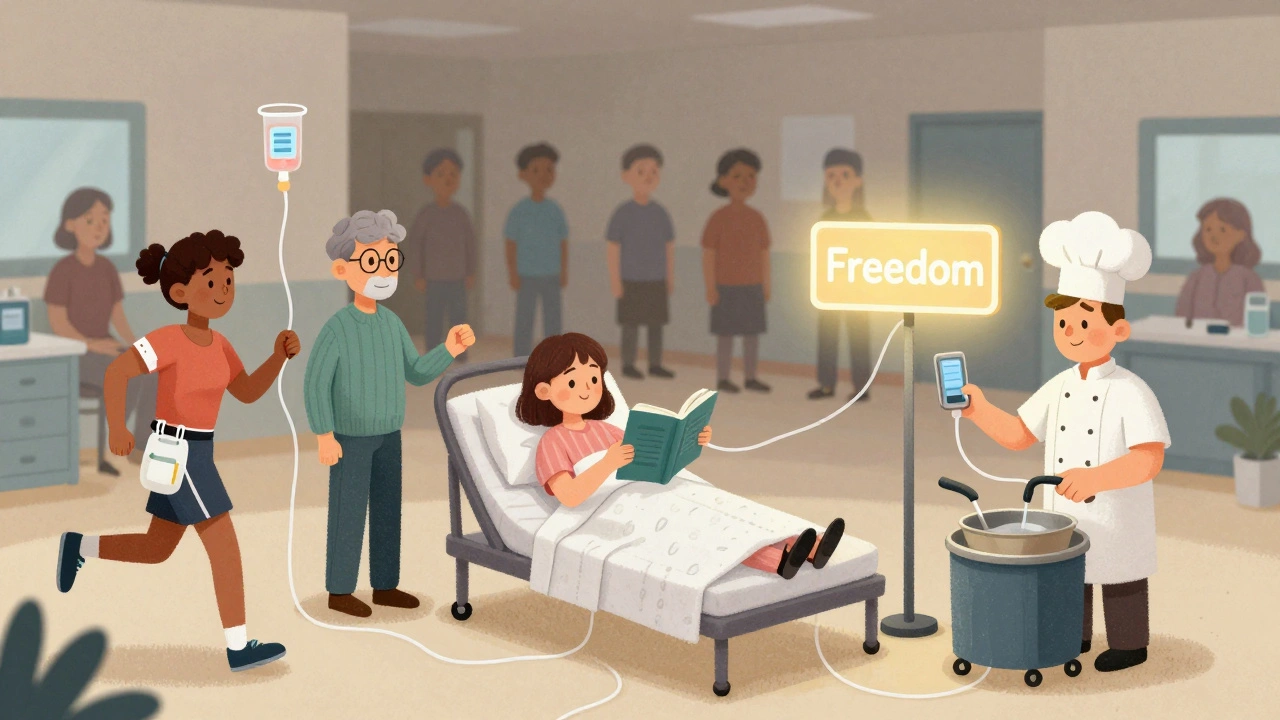
PD users talk about the catheter. Seventy-eight percent said they’re always aware of it-itching, catching on clothes, worrying about infections. Sixty-five percent fear peritonitis. But they also say they love the freedom. No more waiting for a dialysis chair. No more long drives to the center. They can sleep in, work late, or go on trips without planning around treatment.
One patient wrote: "I used to dread my dialysis days. Now I do my exchanges while I watch Netflix. I feel more like myself."
What’s Next?
Neither treatment is perfect. But the idea that hemodialysis is "better" is outdated. PD isn’t just a backup option-it’s a first-line choice for many. The data supports it. The patient experience supports it. The cost savings support it.
If you’re newly diagnosed with kidney failure, ask your doctor about both options-not just the one they offer most often. Ask about training for PD. Ask about home HD. Ask about transplant. You have more control than you think.
There’s no one-size-fits-all. Your body, your life, your strengths-those matter more than statistics. The goal isn’t just to survive. It’s to live.
Can I switch from hemodialysis to peritoneal dialysis later?
Yes, many people switch. If you start with hemodialysis and later find it’s too disruptive to your life, you can transition to peritoneal dialysis-assuming your abdomen is healthy and you’re physically able to manage the daily exchanges. Your doctor will check for scarring, infections, or other issues before approving the switch. It’s not automatic, but it’s common enough that most nephrology teams have experience helping patients make the change.
Is peritoneal dialysis safe for older adults?
It can be, but it depends. Older adults with good vision, steady hands, and mental clarity often do well on PD. But if someone has dementia, severe arthritis, or can’t follow complex steps, PD becomes risky. In those cases, hemodialysis at a clinic may be safer because trained staff handle everything. Many older patients start with HD and switch to PD only if they remain independent and motivated. There’s no age limit-just practical limits based on ability.
How often do I need to go to the doctor with peritoneal dialysis?
You’ll still see your nephrologist regularly-usually every month or two. But you won’t need to go three times a week. You’ll check your weight, blood pressure, and dialysis records at home. Your clinic will review lab results and adjust your dialysis solution strength or dwell times. You’ll also get routine checks for peritonitis risk and catheter health. The frequency is less than HD, but the responsibility is higher.
What happens if I get an infection with peritoneal dialysis?
Peritonitis is the biggest risk with PD. If you notice cloudy dialysis fluid, belly pain, fever, or nausea, call your clinic immediately. You’ll likely start antibiotics right away-often taken orally at home. Most cases clear up in 7 to 10 days with proper treatment. If it doesn’t improve, you might need to switch to hemodialysis temporarily while your abdomen heals. In rare cases, the catheter has to be removed. But with good hygiene, most people never get a serious infection.
Can I travel with peritoneal dialysis?
Yes, and many PD users do. You can pack dialysis fluid in coolers or ship it ahead. For CAPD users, you can do exchanges in hotel rooms, airports, or even on planes (with approval). APD users can bring their cycler and use it in any clean space. Most dialysis centers can help you arrange supplies overseas. You’ll need a plan, but PD is far more portable than in-center hemodialysis, which requires scheduling appointments weeks in advance.
Does diet change with peritoneal dialysis vs. hemodialysis?
Yes, but differently. With hemodialysis, you need strict limits on potassium, sodium, and fluids because you only get cleaned three times a week. With PD, since filtration is continuous, you can usually eat more potassium-rich foods like bananas and potatoes. Fluid intake is still controlled, but less tightly. However, PD uses glucose-based solutions, which can add extra calories-so you may need to watch your sugar and calorie intake to avoid weight gain. Your dietitian will tailor your plan based on your modality.
Is one treatment better for kidney transplant candidates?
Both can prepare you for a transplant. But PD often helps you stay healthier while waiting. It preserves residual kidney function longer and causes less stress on your heart and blood vessels. That means you’re in better shape when a kidney becomes available. Many transplant centers actually prefer patients on PD because they tend to recover faster after surgery. Being on dialysis doesn’t disqualify you-it’s just a bridge. And PD may help you cross it stronger.
Final Thoughts
Choosing between hemodialysis and peritoneal dialysis isn’t about which is stronger. It’s about which fits your life. Hemodialysis gives you less responsibility but more rigidity. Peritoneal dialysis gives you freedom-but it asks you to be your own caregiver. Neither is easy. Both require discipline. But the data is clear: PD is not a second choice. It’s a smart, effective, and often better option for many people. Talk to your team. Ask questions. Don’t accept the default. Your kidneys may be failing, but your life doesn’t have to stop.



Ronald Ezamaru
9 December / 2025I've been on PD for 3 years now. The first month was brutal-learning sterile technique, dealing with the catheter, worrying about infections. But now? I do exchanges while I make coffee. No more 3-hour drives to the clinic. No more feeling like a zombie for 24 hours after treatment. It’s not easy, but it’s mine. And I’m still working full-time, hiking on weekends, and sleeping in. This isn’t just survival-it’s living.
Don’t let anyone tell you HD is "better." It’s just different. And if your body can handle PD, go for it.